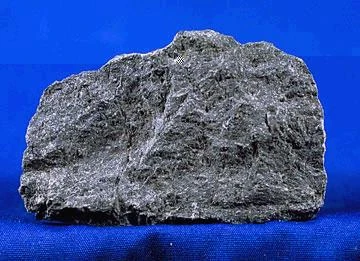
Dolomite (mineral)
A carbonate mineral with a complex formation history and wide industrial use.

Dolomite is a carbonate mineral that contains no water, made of calcium magnesium carbonate with the ideal formula CaMg(CO3)2. The same name is also used for a sedimentary rock made mostly of this mineral, sometimes called dolostone. Dolomite crystals belong to the trigonal-rhombohedral system and can be white, tan, gray, or pink. It is a double carbonate with alternating calcium and magnesium ions in its structure. Unlike calcite, it does not fizz or dissolve quickly in cold dilute hydrochloric acid unless it is a fine powder. Crystal twinning is common. The mineral forms a solid solution with iron-rich ankerite and manganese-rich kutnohorite. Small amounts of iron tint the crystals yellow to brown. Manganese can replace some of the magnesium, up to about three percent MnO, giving a rosy pink color. Lead, zinc, and cobalt can also substitute for magnesium. Dolomite is closely related to huntite, Mg3Ca(CO3)4. Because slightly acidic water can dissolve dolomite, areas where it is a major rock-forming mineral are important as aquifers and contribute to karst landscapes. Modern dolomite forms under anaerobic conditions in supersaturated saline lagoons, such as Lagoa Vermelha and Brejo do Espinho on the coast of Rio de Janeiro, Brazil. It also forms along sabkhas in the Persian Gulf, in sedimentary basins with gas hydrates, and in hypersaline lakes. Dolomite often nucleates with help from sulfate-reducing bacteria like *Desulfovibrio brasiliensis*, though other microbial metabolisms can also mediate its formation. Low-temperature dolomite occurs in natural supersaturated environments rich in extracellular polymeric substances and microbial cell surfaces, likely due to the binding of magnesium and calcium by carboxylic acids in those substances. Large dolomite deposits exist in the geological record, but the mineral is relatively rare in the last 66 million years (the Cenozoic) and in modern settings. No reproducible inorganic low-temperature synthesis of dolomite has been achieved. Usually, a metastable precursor like magnesiu
- chemical_formula
- CaMg(CO3)2
- crystal_system
- Trigonal-rhombohedral
- color
- White, tan, gray, or pink
- named_after
- Déodat Gratet de Dolomieu
- common_uses
- Ornamental stone, concrete aggregate, magnesium source, flux for smelting, pH buffer in horticulture
Lore & Background
Modern dolomite formation has been found to occur under anaerobic conditions in supersaturated saline lagoons such as those at the Rio de Janeiro coast of Brazil. It is often thought that dolomite nucleates with the help of sulfate-reducing bacteria, but other microbial metabolisms have also been found to mediate in dolomite formation. Vast deposits of dolomite are present in the geological record, but the mineral is relatively rare in the Cenozoic and in modern environments. Reproducible, inorganic low-temperature syntheses of dolomite are yet to be performed.
Reader's Guide
Dolomite is significant both as a mineral and as a rock-forming component. It is an important petroleum reservoir rock and serves as the host rock for large strata-bound Mississippi Valley-Type ore deposits of base metals such as lead, zinc, and copper. Because dolomite can be dissolved by slightly acidic water, areas where it is abundant are important as aquifers and contribute to karst terrain formation. Its uses range from ornamental stone and concrete aggregate to a source of magnesium oxide and a flux for smelting iron and steel. In horticulture, it is added to soils as a pH buffer and magnesium source. Calcined dolomite is used as a catalyst for destruction of tar in biomass gasification. Particle physics researchers build detectors under layers of dolomite because it contains relatively minor quantities of radioactive materials, insulating against cosmic rays without adding to background radiation. The mineral is also highly valued by collectors and museums when it forms large, transparent crystals, with specimens from Eugui, Navarra, Spain considered among the best in the world.
Did You Know?
- Modern dolomite formation has been found to occur under anaerobic conditions in supersaturated saline lagoons in Brazil.
- A still perplexing example of an organogenic origin is the reported formation of dolomite in the urinary bladder of a Dalmatian dog.
Origins of the Name and Early Identification
The mineral we know as dolomite carries a name that traces back to a chain of eighteenth-century naturalists. Chemically, dolomite is an anhydrous double carbonate with the ideal formula CaMg(CO3)2, and the term extends beyond the pure mineral to describe a sedimentary carbonate rock dominated by it—a rock type sometimes called dolostone in modern usage.
Crystal Structure and Chemical Personality
Dolomite crystallizes in the trigonal-rhombohedral system, producing crystals that range in color from pure white through tan and gray to a soft pink. Its internal architecture is a double carbonate in which calcium and magnesium ions alternate in a regular lattice, a structural motif that closely relates it to huntite, Mg3Ca(CO3)4. One of the mineral's most practical distinguishing features is its sluggish reaction to cold, dilute hydrochloric acid: unlike calcite, which fizzes almost immediately, dolomite in its crystalline form resists rapid dissolution and effervescence unless ground to a fine powder. Crystal twinning is a common occurrence. The structure also accommodates a range of trace substitutions. Small amounts of iron impart a yellow-to-brown hue, while manganese—present up to roughly three percent as MnO—can push the color toward rosy pink. Lead, zinc, and cobalt may likewise replace magnesium. Dolomite sits at one end of a solid-solution series that extends through the iron-dominant ankerite to the manganese-dominant kutnohorite. Because slightly acidic water can dissolve it, regions rich in dolomite bedrock serve as important aquifers and are central to the development of karst landscapes.
The Formation Puzzle and Microbial Mediation
Despite vast dolomite deposits filling the geological record, the mineral is conspicuously scarce in the Cenozoic—Earth's most recent 66 million years—and remains stubbornly difficult to synthesize in the lab. Reproducible, inorganic low-temperature syntheses have yet to be achieved. Geologists frame this gap as 'breaking Ostwald's step rule': a metastable precursor like magnesium calcite must slowly transform into a more stable, partially ordered dolomite through repeated cycles of dissolution and re-precipitation. Modern dolomite precipitates under anaerobic conditions in supersaturated saline lagoons, notably Lagoa Vermelha and Brejo do Espinho on Brazil's coast, along sabkhas in the Persian Gulf, and in hypersaline lakes. Sulfate-reducing bacteria such as Desulfovibrio brasiliensis are often credited with aiding nucleation, though other microbial metabolisms also participate. In low-temperature settings, extracellular polymeric substances and microbial cell surfaces appear to complex both magnesium and calcium via carboxylic acids. High-temperature diagenesis along deeply rooted fault systems and in deeply buried limestones represents another major pathway, while in Australia's continental saline lakes, high salinity, elevated magnesium-to-calcium ratios, and strong alkalinity create favorable conditions. A striking biotic experiment showed ordered dolomite precipitating when anoxygenic photosynthesis proceeded alongside manganese(II), and a baffling organogenic case was reported in the urinary bladder of a Dalmatian dog, likely linked to illness.
From Glassworks to Particle Detectors
Dolomite's utility spans an astonishing range of industrial, agricultural, and scientific applications. In manufacturing, it serves as an ornamental stone, a concrete aggregate, and a source of magnesium oxide, and it feeds the Pidgeon process for producing metallic magnesium. When calcite limestone is scarce or too expensive, dolomite substitutes as a flux in iron and steel smelting, and large quantities of processed dolomite go into float-glass production. Dolomite also acts as an important petroleum reservoir rock and hosts large strata-bound Mississippi Valley-Type ore deposits of lead, zinc, and copper. Calcined dolomite functions as a catalyst for destroying tar during high-temperature biomass gasification. In horticulture and environmental remediation, dolomitic lime is added to soils and potting mixes to buffer pH and supply magnesium; it limes pastures suffering from magnesium deficiency and regenerates soils damaged by mining. Marine aquarists rely on dolomite as a substrate to stabilize saltwater pH. In particle physics, researchers build detectors beneath layers of dolomite because the mineral's low content of radioactive impurities lets it shield against cosmic-ray interference without elevating background radiation. Among collectors and museums, large transparent dolomite crystals are highly prized, with specimens from the magnesite quarry at Eugui in Esteribar, Navarra, Spain, regarded as among the finest in the world.
Frequently Asked Questions
Who is Dolomite (mineral)?
Dolomite is a double carbonate mineral built from alternating calcium and magnesium ions in a trigonal-rhombohedral lattice, with the ideal formula CaMg(CO3)2. The name honors French naturalist Déodat Gratet de Dolomieu, who first described the species in the late 1700s.
What are Dolomite (mineral)'s powers and role in the world?
In everyday applications it acts as a magnesium source for agriculture, a flux in metal smelting, a pH buffer for horticulture, and an ornamental or aggregate stone in construction. Its crystals can appear white, tan, gray, or pink and frequently display twinning.
How does Dolomite (mineral)'s story end in the geological record?
Dolomite typically forms when magnesium-rich fluids gradually replace calcium in pre-existing limestone over millions of years, a process known as dolomitization. The final product is either the pure mineral or a sedimentary rock called dolostone, often preserved in layered marine deposits.
Why is Dolomite (mineral) important to fans and industry alike?
Its slow reaction to cold dilute hydrochloric acid—unlike calcite—makes it a dependable magnesium reservoir for smelting, concrete, and soil amendment. That same chemical stability also lets it buffer pH in horticultural settings, supporting plant growth season after season.
What separates Dolomite from Calcite when you're out in the field?
Dolomite contains magnesium alongside calcium and will not fizz readily in cold dilute HCl unless ground to a fine powder, whereas calcite reacts almost instantly. Dolomite also commonly shows characteristic crystal twinning, a habit rarely seen in calcite specimens.
More in Rocks And Minerals 25-29
Elsewhere in the Rocks And Minerals universe
Spotted an error? Know more?
This is a living reference — every entry is fact-audited, and reader corrections feed straight into our audit queue. Suggest an edit · See this site's audit record