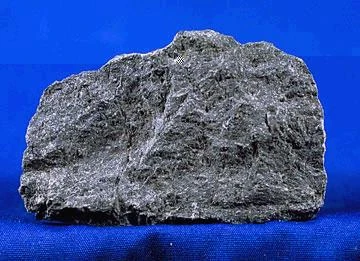
Fayalite
Iron-rich olivine end-member stable with quartz at low pressure.

Fayalite (chemical formula Fe₂SiO₄, often shortened to Fa) sits at the iron-rich end of the olivine solid-solution series. Like all olivine-group minerals, it forms crystals in the orthorhombic system, with unit-cell dimensions of a = 4.82 Å, b = 10.48 Å, and c = 6.09 Å. It can mix in a solid solution with forsterite (Mg₂SiO₄), the magnesium end-member, as well as with tephroite (Mn₂SiO₄), the manganese-rich end-member. Iron-rich olivine turns up fairly often in acidic and alkaline igneous rocks—things like volcanic obsidians, rhyolites, trachytes, phonolites, and plutonic quartz syenites, where it hangs out with amphiboles. Its main home, though, is in ultramafic volcanic and plutonic rocks; it shows up less in felsic plutonic rocks and only rarely in granite pegmatite. You can also find it in lithophysae inside obsidian, as well as in medium-grade thermally metamorphosed iron-rich sediments and impure carbonate rocks. At low pressures, fayalite can coexist with quartz, something more magnesium-rich olivine cannot do. That’s because magnesian olivine reacts with quartz to form orthopyroxene, but iron stabilizes the olivine-plus-quartz pair. The way this reaction depends on pressure and composition lets geologists figure out the pressures under which olivine and quartz assemblages formed. Fayalite also reacts with oxygen to produce magnetite and quartz; together, these three minerals make up the “FMQ” oxygen buffer. Scientists use this reaction to control oxygen fugacity in lab experiments, and it can also help calculate the oxygen fugacity recorded by mineral assemblages from metamorphic and igneous settings. Under high pressure, fayalite transforms directly into ahrensite, the iron-bearing equivalent of ringwoodite. Unlike forsterite, there’s no intermediate phase like wadsleyite. In Earth’s upper mantle, this transition happens at about 6–7 GPa—significantly lower pressure than forsterite’s phase changes. In high-pressure experiments, the transformation can be sluggish, so fayalite may stay stable up to nearly 35 GPa, at which point it might turn amorphous instead of forming a crystalline structure like ahrensite.
- chemical_formula
- Fe2SiO4
- crystal_system
- Orthorhombic (space group Pbnm)
- cell_parameters
- a = 4.82 Å, b = 10.48 Å, c = 6.09 Å
- solid_solution_series
- Forsterite (Mg2SiO4) and tephroite (Mn2SiO4)
- key_reaction
- FMQ oxygen buffer (fayalite + oxygen = magnetite + quartz)
Lore & Background
Fayalite is a mineral that forms solid solution series with forsterite and tephroite. It occurs in acidic and alkaline igneous rocks such as obsidians, rhyolites, trachytes, phonolites, and quartz syenites, as well as in ultramafic volcanic and plutonic rocks, felsic plutonic rocks, granite pegmatite, lithophysae in obsidian, medium-grade thermally metamorphosed iron-rich sediments, and impure carbonate rocks. Its stability with quartz at low pressures contrasts with more magnesian olivine, which reacts with quartz to form orthopyroxene; iron stabilizes the olivine + quartz pair, allowing pressure constraints to be calculated.
Reader's Guide
Fayalite is significant in petrology and geochemistry for several reasons. Its stability with quartz provides a means to estimate pressures of formation for olivine + quartz assemblages. The FMQ oxygen buffer reaction (fayalite + oxygen = magnetite + quartz) is widely used in laboratory experiments to control oxygen fugacity and to calculate fugacity recorded in natural metamorphic and igneous rocks. At high pressure, fayalite transforms directly to ahrensite (the iron analogue of ringwoodite) without an intermediate wadsleyite-like phase, and this transition occurs at about 6–7 GPa under upper mantle conditions—substantially lower than forsterite's transitions. In experiments, the transformation may be delayed to nearly 35 GPa, where fayalite may become amorphous rather than crystalline. These properties make fayalite a key mineral for understanding mantle processes, redox conditions, and phase behavior in Earth's interior.
Did You Know?
- It is stable with quartz at low pressures, unlike more magnesian olivine.
- At high pressure, fayalite transforms directly to ahrensite without an intermediate wadsleyite-like phase.
- The FMQ oxygen buffer uses the reaction of fayalite with oxygen to produce magnetite and quartz.
Frequently Asked Questions
What is Fayalite?
Fayalite is the iron-dominant end-member of the olivine mineral family, with the chemical composition Fe₂SiO₄. In mineralogical shorthand it's abbreviated as 'Fa' and represents the maximum iron an olivine lattice can accommodate.
What crystal system does Fayalite belong to?
Fayalite crystallizes in the orthorhombic system under the space group Pbnm. Its unit-cell dimensions are roughly 4.82 Å along a, 10.48 Å along b, and 6.09 Å along c.
How does Fayalite relate to forsterite and tephroite?
Fayalite, forsterite (Mg₂SiO₄), and tephroite (Mn₂SiO₄) all share the same olivine structure and can substitute for one another in a continuous solid-solution series. Natural olivine grains therefore span a full range of Fe–Mg–Mn compositions rather than existing as three separate minerals.
In what rocks is Fayalite typically found?
Iron-rich olivine occurs in a variety of igneous settings, including volcanic obsidian, rhyolite, trachyte, and phonolite, as well as plutonic quartz syenite. It is notably stable in the presence of quartz at relatively low pressures, a fact petrologists use to constrain formation conditions.
Why is Fayalite important in geochemistry?
Fayalite is a key phase in the FMQ oxygen buffer, where it equilibrates with oxygen to form magnetite and quartz. This reaction serves as a standard reference for gauging the redox state of magmatic and metamorphic systems.
More in Rocks And Minerals 1-24
Elsewhere in the Rocks And Minerals universe
Spotted an error? Know more?
This is a living reference — every entry is fact-audited, and reader corrections feed straight into our audit queue. Suggest an edit · See this site's audit record