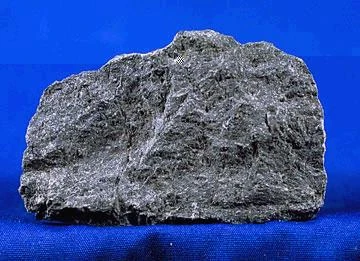
Dolomite (rock)
Sedimentary carbonate rock named after French geologist Déodat Gratet de Dolomieu.

Dolomite is a sedimentary carbonate rock composed of more than 50% of the mineral dolomite, CaMg(CO3)2. It occurs widely, often in association with limestone and evaporites, though it is less abundant than limestone. While dolomite is common in ancient rocks, significant deposits also exist in Cenozoic rock beds (less than about 66 million years old), such as in the Persian Gulf, Bahamas, and Australia. The rock is named after the French mineralogist and geologist Déodat Gratet de Dolomieu, who first distinguished it from limestone in the late 18th century.
- type
- Sedimentary carbonate rock
- composition
- More than 50% mineral dolomite (CaMg(CO3)2)
- named_after
- Déodat Gratet de Dolomieu (French mineralogist and geologist)
- distinctive_feature
- Effervesces only when powdered or with warm dilute hydrochloric acid; weathers to dull yellow-brown
- common_associations
- Limestone and evaporites
- economic_importance
- Oil and natural gas reservoir when porous
Lore & Background
Dolomite rock was first distinguished from limestone by Déodat Gratet de Dolomieu in the late 18th century. In old USGS publications, dolomite was referred to as magnesian limestone.
Reader's Guide
Most dolomite was formed as a magnesium replacement of limestone or lime mud before lithification, a process called dolomitization. The 'dolomite problem' refers to the vast worldwide depositions of dolomite in the past geologic record in contrast to limited modern formation. Sulfate-reducing bacteria in anoxic conditions can precipitate dolomite, suggesting microbial activity may explain some ancient deposits. Dolomite is resistant to erosion, less soluble than limestone in weakly acidic groundwater, and can develop karst features. Subsurface dolomite is generally more porous than limestone and makes up 80% of carbonate rock petroleum reservoirs. The rock is usually granular, resembling sugar grains, and under a microscope often shows well-shaped rhombs with considerable pore space. Dolomite consisting of well-formed grains with planar surfaces is described as planar or idiotopic dolomite; poorly-formed grains with irregular surfaces are nonplanar or xenotopic dolomite, likely formed by recrystallization at elevated temperatures.
Did You Know?
- Dolomite is named after French mineralogist and geologist Déodat Gratet de Dolomieu, who first distinguished it from limestone in the late 18th century.
- The 'dolomite problem' refers to the contrast between vast ancient dolomite deposits and limited modern formation.
- Sulfate-reducing bacteria living in anoxic conditions can precipitate dolomite.
- Subsurface dolomite makes up an estimated 50–80% of carbonate rock petroleum reservoirs due to its high porosity.
Origins of the Name
Today the term carries a dual identity: it refers both to the anhydrous carbonate mineral with the ideal formula CaMg(CO3)2 and to the sedimentary carbonate rock dominated by that mineral, sometimes called dolostone. This dual usage reflects the mineral's importance as both a crystalline species and a major rock-forming component in the geological record.
Crystal Structure and Color Variations
In the trigonal-rhombohedral crystal system, dolomite can appear as white, tan, gray, or pink crystals, and crystal twinning is a common feature. Its defining structural characteristic is that of a double carbonate, with calcium and magnesium ions arranged in an alternating pattern throughout the lattice. This arrangement gives the mineral a distinctive chemical behavior: unlike calcite, dolomite does not rapidly effervesce in cold dilute hydrochloric acid unless ground to a fine powder. The structure is remarkably accommodating to ionic substitution. Iron can replace some magnesium, lending a yellow to brown tint, while manganese—present up to roughly three percent as MnO—produces a rosy pink hue. Lead, zinc, and cobalt can also occupy magnesium sites. Dolomite sits within a solid solution series alongside the iron-dominant ankerite and the manganese-dominant kutnohorite, and it is closely related to the mineral huntite, Mg3Ca(CO3)4.
The Formation Puzzle
Despite vast dolomite deposits in the geological record, the mineral is notably scarce in the Cenozoic era and in modern environments, and reproducible inorganic low-temperature syntheses remain elusive. Modern formation has been documented in anaerobic, supersaturated saline lagoons along the Rio de Janeiro coast of Brazil, along sabkhas in the Persian Gulf, in hypersaline lakes, and in sedimentary basins hosting gas hydrates. Sulfate-reducing bacteria such as Desulfovibrio brasiliensis are often credited with nucleating dolomite, though other microbial metabolisms also play a role, and the process likely involves extracellular polymeric substances complexing both magnesium and calcium. In the laboratory, a metastable precursor like magnesium calcite forms easily but must undergo repeated dissolution and re-precipitation to reach a stable, partially ordered dolomite—a process described as breaking Ostwald's step rule. High-temperature diagenesis along deep fault systems also drives dolomitization, while in some Neogene platforms, long-term subsurface biosphere activity linked to Milankovitch climate cycles may be responsible. A truly perplexing case involves dolomite reportedly forming in the urinary bladder of a Dalmatian dog.
From Industry to Particle Physics
Dolomite's utility spans an extraordinary range of applications. Industrially, it serves as a source of magnesium oxide and feeds the Pidgeon process for magnesium production. It is a critical petroleum reservoir rock and hosts large strata-bound Mississippi Valley-Type ore deposits of lead, zinc, and copper. Where calcite limestone is scarce or expensive, dolomite acts as a flux in iron and steel smelting, and large volumes of processed dolomite go into float glass manufacturing. In horticulture, dolomitic lime buffers soil pH and supplies magnesium to pastures and potting mixes, while also aiding environmental restoration in mining-affected soils. In marine aquariums, dolomite substrate helps stabilize saltwater pH. In particle physics, researchers construct detectors beneath layers of dolomite because its low radioactivity insulates against cosmic-ray interference without elevating background radiation. Finally, collectors and museums prize large, transparent dolomite crystals, with specimens from the magnesite quarry at Eugui in Navarra, Spain, regarded among the finest in the world.
Frequently Asked Questions
What is Dolomite (rock)?
Dolomite is a sedimentary carbonate rock in which more than half of the material is the mineral dolomite, CaMg(CO3)2. It is found worldwide, frequently alongside limestone and evaporite deposits, though it is considerably less abundant than limestone.
How do I tell Dolomite apart from Limestone in the field?
The classic test is that dolomite will only fizz with cold dilute hydrochloric acid if you first crush it to a powder or warm the acid, whereas limestone reacts readily on its own. Dolomite also tends to weather to a dull yellow-brown hue, giving it a distinct look compared to the paler limestone.
Who is Dolomite named after?
The rock takes its name from Déodat Gratet de Dolomieu, a French mineralogist and geologist who was the first person to clearly distinguish this carbonate rock from limestone in the late 18th century.
Where is Dolomite commonly found?
It occurs widely in ancient rock sequences and is frequently associated with limestone and evaporite formations. Significant younger (Cenozoic, under roughly 66 million years old) deposits are found in the Persian Gulf, the Bahamas, and parts of Australia.
Why is Dolomite (rock) economically important?
When it develops enough porosity, dolomite acts as a major reservoir rock for oil and natural gas. Its widespread presence in sedimentary basins makes it a key target for hydrocarbon exploration and production.
More in Rocks And Minerals 25-29
Elsewhere in the Rocks And Minerals universe
Spotted an error? Know more?
This is a living reference — every entry is fact-audited, and reader corrections feed straight into our audit queue. Suggest an edit · See this site's audit record