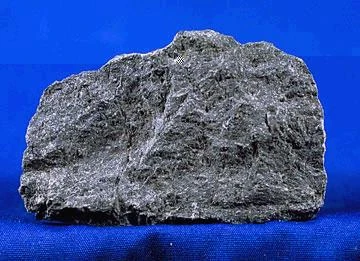
Hauyne
Rare blue feldspathoid mineral of the sodalite group.

Hauyne, also known as haüyne, hauynite, haüynite, or azure spar, is a rare tectosilicate sulfate mineral with the endmember formula Na3Ca(Si3Al3)O12(SO4). Hauyne is sometimes used as a gemstone.
- field
- Mineralogy
- type
- Tectosilicate sulfate mineral
- formula
- Na3Ca(Si3Al3)O12(SO4)
- crystal_system
- Isometric, hexatetrahedral class (43m)
- hardness
- 5½ to 6
- specific_gravity
- 2.44 to 2.50
- refractive_index
- 1.50
Lore & Background
It crystallizes in the isometric system, forming rare dodecahedral or pseudo-octahedral crystals that may reach 3 cm across, and also occurs as rounded grains. The color is usually bright blue, but can also be white, grey, yellow, green, and pink. The mineral is transparent to translucent with a vitreous to greasy luster.
Reader's Guide
Hauyne is significant as a rare member of the sodalite group of feldspathoid minerals, notable for its bright blue color and its occurrence in silica-poor igneous rocks such as phonolites and leucite- or nepheline-rich lavas. Hauyne is the densest member of the sodalite group, with specific gravity 2.44 to 2.50, and has the highest refractive index (1.50) among them. It can be distinguished from sodalite by treating with nitric acid, which yields monoclinic gypsum needles rather than cubic chlorite crystals. Notable localities include the type locality at Lake Nemi, Alban Hills, Italy, as well as occurrences in the Canary Islands, Ecuador, Germany, and several sites in the United States.
Did You Know?
- It is the densest member of the sodalite group, with specific gravity 2.44 to 2.50.
- The mineral can be distinguished from sodalite by treating with nitric acid, which forms monoclinic gypsum needles.
- Hauyne may show reddish orange to purplish pink fluorescence under longwave ultraviolet light.
Frequently Asked Questions
Who is Hauyne?
Hauyne is a rare blue feldspathoid mineral that belongs to the sodalite group, with the endmember formula Na3Ca(Si3Al3)O12(SO4). You may also encounter it listed under the alternate names haüyne, hauynite, or azure spar.
What are Hauyne's key physical properties?
It crystallizes in the isometric system with a hexatetrahedral habit (43m point group), and measures 5½ to 6 on the Mohs hardness scale. Its specific gravity falls between 2.44 and 2.50.
How is Hauyne used in the real world?
Because of its vivid blue color, Hauyne is occasionally cut and set as a gemstone. More commonly it is prized as a collector's specimen given how scarce it is in nature.
Why is Hauyne important to mineralogy?
As a feldspathoid, it forms in sodium-rich, silica-poor igneous settings and helps geologists reconstruct the chemistry of those magmatic environments. Its placement within the sodalite group also gives mineralogists a useful reference point for classifying closely related species.
What does Hauyne look like?
It is instantly recognizable by its deep, striking blue color and its hexatetrahedral crystal shape. In hand specimen it typically appears as small, vividly blue crystals or as compact, massive aggregates.
More in Rocks And Minerals 1-24
Elsewhere in the Rocks And Minerals universe
Spotted an error? Know more?
This is a living reference — every entry is fact-audited, and reader corrections feed straight into our audit queue. Suggest an edit · See this site's audit record