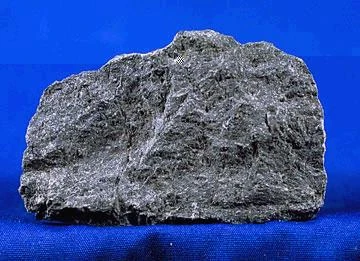
Greywacke
A dark, hard sandstone formed by ancient submarine avalanches.

Greywacke, also spelled graywacke, is a type of sandstone that stands out for being unusually hard (scoring 6–7 on the Mohs scale), dark in color, and made of angular, poorly sorted grains. These grains are a mix of quartz, feldspar, and small rock fragments, all held together by a compact, clay-rich matrix. Because of this messy texture, geologists call it an immature sedimentary rock, and it is most often found in Paleozoic rock layers. The larger particles can range from sand to gravel size, and the matrix makes up more than 15 percent of the rock’s volume. For a long time, no one understood how greywacke formed—under normal sedimentation rules, gravel, sand, and mud shouldn’t settle together. The answer came with the discovery of turbidity currents and turbidites. Today, geologists believe greywacke is created by submarine avalanches or powerful turbidity currents that churn up sediment into a mixed slurry. These deposits often show a variety of sedimentary features. Evidence for this theory includes the fact that greywacke is found on the edges of continental shelves, at the bottoms of ocean trenches, and near mountain-building zones. It also appears alongside black shales that form in deep-sea environments. Typically, greywacke itself doesn’t contain fossils, though fossils can turn up in the finer layers associated with it. The grains are usually not very rounded or polished, and the rock has often been hardened by recrystallization—for example, when silica seeps in between particles. In some areas, greywacke shows cleavage, but not as perfectly as slate does. Even though the group is so varied that it’s hard to pin down a single mineral makeup, it holds a firm place in rock classifications because these gritty, mixed sandstones are very common in Silurian and Cambrian rocks, and less so in Mesozoic or Cenozoic ones. Their key traits are their gritty feel and complex composition. With increasing metamorphism, greywacke often turns into mica-schists, chloritic schists, or sedimentary gneisses. The term “greywacke” can be confusing because it can refer either to the rock’s immature, fragment-rich nature or to its fine-grained clay component. Most greywackes are dull-colored—grey, brown, yellow, or black—and appear in thick or thin beds alongside shales and limestones. Some varieties include feldspathic greywacke, which is rich in feldspar, and lithic
- type
- Sedimentary rock (sandstone variety)
- hardness
- 6–7 on Mohs scale
- composition
- Quartz, feldspar, lithic fragments, clay-fine matrix
- matrix proportion
- More than 15% by volume
- common eras
- Paleozoic (especially Silurian and Cambrian); less common in Mesozoic or Cenozoic
- notable locations
- Wales, south of Scotland, Longford-Down Massif in Ireland, Lake District of England, Southern Alps of New Zealand, Ecca Group in South Africa, Eastern Desert east of the Nile
Lore & Background
Greywacke deposits are found on the edges of continental shelves, at the bottoms of oceanic trenches, and at the bases of mountain formational areas, often in association with black shales of deep-sea origin. As a rule, greywackes do not contain fossils, but organic remains may be common in the finer beds associated with them. Their component particles are usually not very rounded or polished, and the rocks have often been considerably indurated by recrystallization, such as the introduction of interstitial silica. In some districts, greywackes are cleaved, but they show phenomena of this kind much less perfectly than the slates. The term 'greywacke' can be confusing, since it can refer to either the immature (rock fragment) aspect of the rock or its fine-grained (clay) component. Varieties include feldspathic greywacke, rich in feldspar, and lithic greywacke, rich in other tiny rock fragments. The cementing material may be siliceous or argillaceous and is sometimes calcareous. By increasing metamorphism, greywackes frequently pass into mica-schists, chloritic schists and sedimentary gneisses. It was interesting because it was found in many places in Britain and its occurrence in particular places was evidence of the pattern of geological strata that had been laid down.
Reader's Guide
Greywacke holds significance as a key rock type for understanding ancient sedimentary processes, particularly the role of turbidity currents in depositing mixed sediments that would otherwise not occur together. Its presence in Paleozoic strata, especially Silurian and Cambrian rocks, makes it a marker for deep-sea or continental margin environments. The rock's hardness and dark color led to its use in ancient Egypt and the Roman world for vessels and sculpture, with the greywacke of Wadi Hammamat identified as the bekhen stone of Egyptian inscriptions. Its fine grain and compact structure allowed detailed carving, and its dark colour could approximate the appearance of bronze. In archaeological literature, Egyptian greywacke has frequently been described as 'basalt', although it is a sedimentary rock rather than volcanic basalt. The rock's legacy includes its role in early British geology and its continued study as an example of texturally immature sedimentary rock.
Did You Know?
- Greywacke's origin was unknown until turbidity currents and turbidites were understood.
- Greywacke deposits are found on the edges of continental shelves, at the bottoms of oceanic trenches, and at the bases of mountain formational areas.
- The greywacke of Wadi Hammamat is generally identified with the bekhen stone named in ancient Egyptian inscriptions.
- In archaeological literature, Egyptian greywacke has frequently been described as 'basalt', although it is a sedimentary rock rather than volcanic basalt.
The Turbidity Revelation and Deep-Sea Origins
For centuries, geologists puzzled over how gravel, sand, and fine mud could end up deposited together in a single rock layer, since standard sedimentation principles dictate that particles of different sizes should settle separately. Greywacke defied this expectation, and its origin remained genuinely mysterious until the mechanisms of turbidity currents and turbidite deposition were finally understood. Today, the prevailing explanation points to submarine avalanches or powerful turbidity currents that violently churn the seafloor, producing a chaotic slurry of mixed sediment sizes that settles all at once. The geographic distribution of greywacke deposits strongly supports this deep-water origin: they appear along continental shelf margins, at the floors of oceanic trenches, and at the bases of mountain-building zones, often lying alongside black shales of deep-sea provenance. As a texturally immature sedimentary rock, greywacke typically occurs in Paleozoic strata, with a Mohs hardness of six to seven, a dark and earthy appearance, and poorly sorted angular grains of quartz, feldspar, and lithic fragments embedded in a clay-rich matrix that makes up more than fifteen percent of the total volume.
Mineralogical Complexity and Metamorphic Destiny
Despite its name suggesting a single, uniform material, greywacke is in reality a remarkably heterogeneous group of rocks that resists neat mineralogical definition. The term itself can cause confusion, since it may refer either to the coarse, rock-fragment-rich aspect of the rock or to its fine-grained clay component. Two principal subtypes are recognized: feldspathic greywacke, dominated by abundant feldspar, and lithic greywacke, packed with tiny fragments of other rocks. Beyond the principal constituents of quartz, orthoclase, plagioclase, calcite, and iron oxides, coarser varieties may incorporate fragments of felsite, chert, slate, gneiss, various schists, and quartzite. A long tail of accessory minerals—biotite, chlorite, tourmaline, epidote, apatite, garnet, hornblende, augite, sphene, and pyrites—adds further variety. The cement binding these grains together can be siliceous, argillaceous, or calcareous. Although greywacke is most abundant in Silurian and Cambrian sequences and becomes rarer in Mesozoic and Cenozoic layers, it holds a firm place in petrographic classification. Under progressive metamorphism, greywacke commonly transforms into mica-schists, chloritic schists, or sedimentary gneisses, marking its transition from a sedimentary product to a metamorphic one.
Sculpture, Empire, and the Basalt Misnomer
In ancient Egypt, a particular fine-grained, compact greywacke quarried at Wadi Hammamat along the trade route between Koptos and the Red Sea was prized for carving vessels and sculpture. Egyptian inscriptions record expeditions to obtain this material, which is generally identified with the bekhen stone mentioned in those texts. Its dense, fine texture permitted intricate detailed carving, while its dark greenish-grey hue—sometimes shifting toward brown—could convincingly mimic the look of bronze. The Romans inherited and expanded this tradition, producing works that ranged from small personal sculptures to truly colossal pieces; the Palatine Colossi, carved for an imperial setting in the late first or early second century AD, stand as particularly grand examples. Yet this sedimentary rock has long suffered a persistent misidentification. Throughout archaeological and antiquarian literature, Egyptian greywacke was routinely called "basalt," a volcanic rock of entirely different origin. Early modern writers compounded the confusion by applying inconsistent labels such as basalto and pietra di paragone to several distinct dark stones, blurring the line between sedimentary and igneous materials in the public and scholarly imagination.
From British Outcrops to Hollywood Miniatures
Greywacke has a strikingly wide geographic footprint. In Britain it is abundant across Wales, the southern Scottish highlands, the Lake District National Park, and the Longford-Down Massif in Ireland, and it was among the first rocks to draw systematic geological attention there, helping to excite public fascination with the science in the early nineteenth century. Beyond the British Isles, greywacke forms the bulk of New Zealand's Southern Alps, appears in both feldspathic and lithic varieties within the Ecca Group of South Africa, and outcrops in the Eastern Desert east of the Nile. In a far more modern context, the rock's unusually mixed grain composition makes it invaluable to practitioners of traditional motion-picture miniature photography: because of that heterogeneous texture, greywacke retains a natural appearance across an extraordinary range of scale ratios, from full-size one-to-one down to ratios as extreme as one-to-six-hundred, a property no single-grain material can match.
Frequently Asked Questions
What is Greywacke?
Greywacke is a dark, unusually hard variety of sandstone that belongs to the sedimentary rock family. It is set apart by its messy, poorly sorted grain structure and a compact clay-rich cement binding everything together.
How hard is Greywacke compared to other sandstones?
It registers between 6 and 7 on the Mohs hardness scale, making it noticeably tougher than most typical sandstones. That extra durability comes from the dense, fine-grained clay matrix that locks the larger particles in place.
What minerals and materials make up Greywacke?
The rock contains a jumble of quartz, feldspar, and small broken rock fragments called lithic grains, ranging from sand to gravel size. All of these are held together by a clay-rich matrix that fills more than 15 percent of the rock's total volume.
Where is Greywacke most commonly found?
It shows up predominantly in Paleozoic strata, especially Cambrian and Silurian layers. Well-known outcrops occur in Wales, the Scottish lowlands, Ireland's Longford-Down Massif, New Zealand's Southern Alps, and South Africa's Ecca Group.
Why do geologists label Greywacke an 'immature' sedimentary rock?
The term points to its angular, poorly sorted grains and the large proportion of fine clay still present in the fabric. A mature sandstone would display well-rounded, well-sorted quartz with minimal matrix, so Greywacke's rough texture signals limited transport and weathering.
More in Rocks And Minerals 1-24
Elsewhere in the Rocks And Minerals universe
Spotted an error? Know more?
This is a living reference — every entry is fact-audited, and reader corrections feed straight into our audit queue. Suggest an edit · See this site's audit record