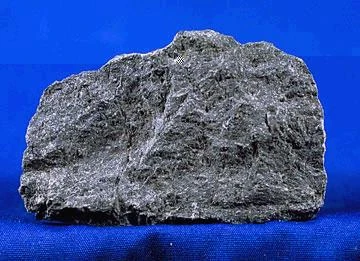
Enstatite
Magnesium-rich pyroxene mineral found in rocks, meteorites, and space.

Enstatite is the magnesium-rich endmember of the pyroxene mineral series that runs from enstatite (MgSiO₃) to ferrosilite (FeSiO₃). Members of this solid-solution series that are rich in magnesium are common rock-forming minerals in igneous and metamorphic rocks. The intermediate composition, (Mg,Fe)SiO₃, was once called hypersthene, but that name is now abandoned in favor of orthopyroxene. When the composition is determined petrographically or chemically, it is expressed as relative proportions of enstatite (En) and ferrosilite (Fs), for example En₈₀Fs₂₀. Most natural enstatite crystals are orthorhombic (space group Pbca), but three polymorphs exist. The high-temperature, low-pressure forms are protoenstatite and protoferrosilite (also orthorhombic, space group Pbcn), while the low-temperature forms, clinoenstatite and clinoferrosilite, are monoclinic (space group P2₁/c). When enstatite containing a small amount of iron weathers, it develops a submetallic luster and a bronze-like color; this material is called bronzite, though it is more accurately described as altered enstatite. An emerald-green variety known as chrome-enstatite is cut as a gemstone, its color coming from traces of chromium. Black, chatoyant hypersthene and brownish bronzite are also used as semi-precious gemstones. Enstatite and other orthorhombic pyroxenes are distinguished from monoclinic pyroxenes by optical characteristics: straight extinction, much weaker double refraction, and stronger pleochroism. They also have perfect prismatic cleavage in two directions at 90 degrees. Enstatite is white, gray, greenish, or brown, with a hardness of 5–6 on the Mohs scale and a specific gravity of 3.2–3.3. This prismatic form is used in gemstones and for academic study. Isolated enstatite crystals are rare, but orthopyroxene is an essential component of many igneous and metamorphic rocks. Magnesian orthopyroxene occurs in plutonic rocks like gabbro (norite) and diorite, and it can form small idiomorphic phenocrysts or groundmass grains in volcanic rocks such as basalt, andesite, and dacite. Enstatite near En₉₀Fs₁₀ in composition is an essential mineral in typical peridotite and pyroxenite of Earth’s mantle. Xenoliths of peridotite are common in kimberlite and some basalt; measurements of calcium, alum
- field
- Mineralogy
- known_for
- Magnesium endmember of the pyroxene series; common in igneous and metamorphic rocks; found in meteorites and in space
- hardness
- 5–6 on Mohs scale
- specific_gravity
- 3.2–3.3
- color
- White, gray, greenish, or brown
Lore & Background
Most natural crystals are orthorhombic (space group Pbca), with three known polymorphs: high-temperature low-pressure protoenstatite and protoferrosilite (orthorhombic, space group Pbcn), and low-temperature clinoenstatite and clinoferrosilite (monoclinic, space group P21/c). Weathered enstatite with a small amount of iron takes on a submetallic luster and bronze-like color, termed bronzite, though it is more correctly called altered enstatite. An emerald-green variety called chrome-enstatite is cut as a gemstone, colored by traces of chromium; black chatoyant hypersthene and brownish bronzite are also used as semi-precious gemstones.
Reader's Guide
Enstatite and other orthorhombic pyroxenes are distinguished from monoclinic series by optical characteristics such as straight extinction, much weaker double refraction, and stronger pleochroism, with perfect prismatic cleavage in two directions at 90 degrees. Isolated crystals are rare, but orthopyroxene is an essential constituent of various igneous and metamorphic rocks. Magnesian orthopyroxene occurs in plutonic rocks like gabbro (norite) and diorite, and as phenocrysts or groundmass grains in volcanic rocks such as basalt, andesite, and dacite. Enstatite close to En90Fs10 is essential in peridotite and pyroxenite of Earth's mantle; measurements of calcium, aluminum, and chromium in enstatite from xenoliths have been crucial in reconstructing depths from which xenoliths were plucked by ascending magmas. Orthopyroxene is important in metamorphic rocks like granulite, and near-pure enstatite occurs in some metamorphosed serpentines. Enstatite is common in meteorites, found in stony and iron meteorites, and together with olivine forms the bulk of some meteorites, sometimes occurring in chondrules with internal radiated structure. It is a main component of E-type asteroids, with the Hungaria asteroids as main examples.
Did You Know?
- Weathered enstatite with a small amount of iron takes on a submetallic luster and bronze-like color, termed bronzite.
Frequently Asked Questions
What is Enstatite?
Enstatite is the magnesium-rich endmember of the pyroxene mineral series, defined by the formula MgSiO₃. It marks one extreme of a solid-solution spectrum that runs all the way to the iron-rich ferrosilite.
Where is Enstatite found?
It is a common rock-forming mineral in both igneous and metamorphic rocks, and it also turns up in meteorites and other extraterrestrial material. Its presence in space samples makes it a key clue for understanding how planetary bodies formed.
What does Enstatite look like and how hard is it?
Natural crystals typically show up as white, gray, greenish, or brown, and they register around 5–6 on the Mohs hardness scale. With a specific gravity of roughly 3.2–3.3, it sits in the moderately dense range for silicate minerals.
How is Enstatite distinguished from other pyroxenes?
Older literature lumped intermediate compositions under the now-abandoned name 'hypersthene,' but modern practice simply reports the En-to-Fs ratio (for example, En₈₀Fs₂₀) to pin down a sample's position. Enstatite specifically represents the pure-magnesium extreme of that orthopyroxene series.
Why is Enstatite important in mineralogy?
As the defining endmember of the orthopyroxene family, it gives geologists a fixed reference point for expressing the composition of every other member. Its widespread occurrence across igneous, metamorphic, and extraterrestrial rocks makes it a cornerstone of petrographic analysis.
More in Rocks And Minerals 1-24
Elsewhere in the Rocks And Minerals universe
Spotted an error? Know more?
This is a living reference — every entry is fact-audited, and reader corrections feed straight into our audit queue. Suggest an edit · See this site's audit record