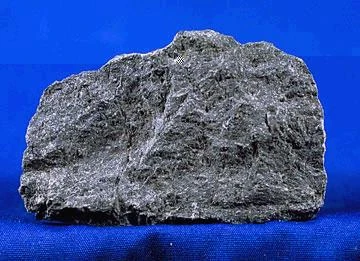
Gabbro
Coarse-grained, mafic intrusive rock forming much of Earth's oceanic crust.

Gabbro (pronounced GAB-roh) is a coarse-grained, intrusive igneous rock that is rich in magnesium and iron, making it mafic. It forms when magma cools slowly deep underground, crystallizing into a solid mass. This rock makes up much of Earth’s oceanic crust, created at mid-ocean ridges, and also appears as plutons linked to continental volcanic activity. A useful comparison: gabbro is to basalt what granite is to rhyolite—both share the same chemistry and mineral makeup, but gabbro cools slowly (coarse-grained) while basalt cools quickly (fine-grained). The name “gabbro” first appeared in the 1760s, used for rock types found in the ophiolites of Italy’s Apennine Mountains, named after the hamlet of Gabbro near Rosignano Marittimo in Tuscany. Petrologically, gabbro is low in silica but high in iron, magnesium, and calcium. Its main minerals are pyroxene (mostly clinopyroxene) and calcium-rich plagioclase, with smaller amounts of hornblende, olivine, and orthopyroxene, plus accessory minerals. If olivine makes up more than 10% of the mafic minerals, the rock is called olivine gabbro; if both orthopyroxene and clinopyroxene are present in significant amounts, it is termed gabbronorite. Hornblende, when present, often appears as rims around augite crystals or as large grains enclosing smaller minerals. Geologists classify coarse-grained igneous rocks using strict quantitative definitions based on mineral content. For rocks with at least 10% quartz, feldspar, or feldspathoid minerals, they use the QAPF diagram, plotting the relative amounts of quartz (Q), alkali feldspar (A), plagioclase (P), and feldspathoid (F). A rock is classified as a gabbroid or dioritoid if quartz is less than 20% of the QAPF content, feldspathoids are under 10%, and plagioclase makes up over 65% of the total feldspar. Gabbroids differ from dioritoids in that their plagioclase has more than 50% anorthite (calcium plagioclase). In the field, where plagioclase composition is hard to determine, the distinction is based on mafic mineral content: gabbroids typically have over 35% mafic minerals (mostly pyroxenes or olivine), while dioritoids have less than 35% (often including hornblende). Gabbroids include related rock types like monzogabbro, quartz gabbro, and nepheline-bearing varieties. Note that norite is a separate rock type defined by orthopyroxene dominance, not a subtype of gabbro.
- type
- Igneous rock
- composition
- Mafic (magnesium- and iron-rich), low in silica
- texture
- Phaneritic (coarse-grained)
- common minerals
- Pyroxene (mostly clinopyroxene) and calcium-rich plagioclase, with minor hornblende, olivine, orthopyroxene
- occurrence
- Oceanic crust, ophiolites, plutons, layered intrusions
- commercial name
- Often called 'black granite' in the dimension stone industry
Lore & Background
The term 'gabbro' was used in the 1760s to name a set of rock types found in the ophiolites of the Apennine Mountains in Italy, named after the hamlet Gabbro near Rosignano Marittimo in Tuscany. Gabbro is composed of pyroxene (mostly clinopyroxene) and calcium-rich plagioclase, with minor amounts of hornblende, olivine, orthopyroxene and accessory minerals. Geologists use rigorous quantitative definitions to classify coarse-grained igneous rocks, based on the mineral content of the rock, using the QAPF diagram. Gabbro itself is more narrowly defined as a gabbroid in which plagioclase makes up more than 90% of the total feldspar content, quartz (if present) is less than 5% of the QAPF content, and feldspathoids are absent or make up less than 5%. There are a number of subtypes of gabbro, but norite is a separate rock type defined by orthopyroxene dominance, not a subtype of gabbro.
Reader's Guide
Gabbro is significant because it is an essential part of the oceanic crust, formed at mid-ocean ridges, and provides insight into the slow crystallization of magma deep beneath the Earth's surface. Its coarse-grained texture and mafic composition make it a key rock type for understanding the processes of igneous differentiation and the formation of layered intrusions. Gabbro is much less common than more silica-rich intrusive rocks in the continental crust, but its presence in ophiolite complexes and lopoliths helps geologists reconstruct ancient tectonic settings and mantle-derived magmatism. The rock's commercial use as 'black granite' in the dimension stone industry highlights its economic importance, though this term is applied loosely to a wide range of intrusive rocks. The detailed classification system for gabbros and gabbroids, based on mineral proportions and the QAPF diagram, allows precise petrological description and comparison across different geological settings. Gabbro's relationship to basalt—sharing the same chemical composition but differing in cooling rate and grain size—illustrates fundamental principles of igneous petrology.
Did You Know?
- Gabbro has the same chemical composition and mineralogy as rapid-cooling, fine-grained basalt.
- The term 'gabbro' was named after the hamlet Gabbro near Rosignano Marittimo in Tuscany, Italy.
- Gabbro is often called 'black granite' commercially in the dimension stone industry.
- A gabbroic rock with less than 10% mafic mineral content is classified as anorthosite.
Formation & Geological Significance
Gabbro forms when magma cools slowly deep beneath the Earth's surface, producing a coarse-grained, fully crystalline rock. Because the cooling process is gradual, mineral grains have ample time to grow large enough to be visible to the naked eye—a characteristic geologists call phaneritic. This rock is mafic in nature, meaning it is rich in magnesium and iron while remaining relatively low in silica. Its chemical makeup and mineral assemblage are essentially identical to those of basalt, the fine-grained volcanic rock that forms when the same magma erupts and solidifies rapidly. This parallel makes gabbro the intrusive counterpart to basalt, much as granite relates to rhyolite. The geological importance of gabbro cannot be overstated. Vast portions of the Earth's oceanic crust are composed of this rock, generated at mid-ocean ridges where tectonic plates diverge and new seafloor is created. On continents, gabbro appears as plutonic bodies linked to volcanic activity. In the commercial dimension stone trade, it is frequently marketed under the informal label "black granite," a name that reflects its dark appearance rather than its true mineralogical identity.
Mineral Composition & Petrological Classification
At its core, gabbro is built from two dominant mineral families: pyroxene, predominantly the clinopyroxene variety known as augite, and calcium-rich plagioclase feldspar. Minor constituents may include hornblende, olivine, orthopyroxene, and various accessory minerals. When olivine or orthopyroxene exceeds ten percent of the total, the rock earns a more specific designation—olivine gabbro or gabbronorite, respectively. Hornblende, when present, often appears as a rim encircling augite crystals or as large poikilitic grains that swallow smaller crystals of other minerals. Geologists rely on the QAPF diagram to place coarse-grained igneous rocks into precise categories. For a rock to qualify as a gabbroid, quartz must constitute less than twenty percent of the QAPF fraction, feldspathoids must stay below ten percent, and plagioclase must exceed sixty-five percent of total feldspar. Within gabbroids, the anorthite fraction of plagioclase must surpass fifty percent to separate them from dioritoids. Strict gabbro narrows the definition further: quartz below five percent, no feldspathoids, and plagioclase above ninety percent of feldspar. In the field, where plagioclase composition is hard to determine, a preliminary split between gabbroid and dioritoid rests on mafic mineral content—gabbroids typically carry more than thirty-five percent mafic minerals.
Subtypes & the Gabbroid Family
Gabbro is not a single, monolithic rock type but rather the anchor of a broader family of coarse-grained mafic igneous rocks. Geologists first divide gabbros by their mafic mineral proportion: leucogabbros carry less than thirty-five percent mafic minerals, mesogabbros fall between thirty-five and sixty-five percent, and melagabbros exceed sixty-five percent. Rocks with more than ninety percent mafic minerals cross into ultramafic territory, while those with fewer than ten percent are reclassified as anorthosite. A finer classification looks at which specific minerals dominate. Normal gabbro, in the strictest sense, consists almost entirely of plagioclase and clinopyroxene. Norite swaps clinopyroxene for orthopyroxene as the principal pyroxene. Troctolite replaces pyroxene with olivine as the dominant mafic phase. Hornblende gabbro features hornblende as the chief mafic mineral alongside plagioclase. Intermediate compositions receive hybrid names: gabbronorite sits between normal gabbro and norite with roughly equal clinopyroxene and orthopyroxene, while olivine gabbro contains substantial olivine but little clinopyroxene or hornblende. Beyond these, gabbros are sometimes labeled alkali or tholeiitic by analogy with their basaltic volcanic equivalents. Alkali gabbro may include olivine, nepheline, or analcime up to ten percent of its mineral content, whereas tholeiitic gabbro contains both pyroxene varieties, effectively making it a gabbronorite.
Etymology & Historical Naming
The name "gabbro" carries a distinctly Italian origin. In the 1760s, geologists applied the term to a group of rock types encountered in the ophiolite sequences of the Apennine Mountains. The word itself was borrowed from Gabbro, a small hamlet situated near Rosignano Marittimo in the Tuscany region. The connection between a modest village and a globally significant rock type is a reminder that much of geological nomenclature is rooted in local geography rather than mineralogical theory. The term's usage did not remain broad for long. Notably, the rocks he labeled "gabbro" would, under modern classification, more accurately be called metagabbro—gabbro that has undergone metamorphic alteration. This historical shift illustrates how geological terminology evolves as understanding deepens. What was once a catch-all label for a suite of dark intrusive rocks has been progressively narrowed through rigorous mineralogical criteria, yet the original name has endured, anchoring an entire family of related rock types in the geologist's vocabulary.
Frequently Asked Questions
What is Gabbro?
Gabbro is a coarse-grained intrusive igneous rock that is rich in magnesium and iron, placing it firmly in the mafic category. It develops when magma cools slowly deep beneath the surface, giving crystals plenty of time to grow large.
What minerals make up Gabbro?
The dominant minerals are clinopyroxene and calcium-rich plagioclase feldspar, often accompanied by minor hornblende, olivine, or orthopyroxene. Overall the rock is low in silica, which is what gives it its characteristic dark, dense appearance.
How is Gabbro related to Basalt?
Gabbro and basalt share the same chemistry and mineral assemblage; the only real difference is cooling speed. Gabbro solidifies slowly underground into coarse grains, while basalt quenches quickly near the surface into fine grains—essentially the mafic equivalent of the granite-versus-rhyolite pairing.
Where is Gabbro found on Earth?
It makes up a large fraction of the oceanic crust generated at mid-ocean ridges and also appears in ophiolite complexes and continental plutons tied to volcanic activity. In the dimension-stone trade, it is commonly marketed under the name 'black granite.'
Why is Gabbro geologically significant?
Because it constitutes the bulk of the oceanic crust, gabbro sits at the heart of plate tectonics and the global rock cycle. Ophiolite exposures that preserve gabbro also offer a rare cross-section of ancient seafloor processes that have been thrust up onto continental margins.
More in Rocks And Minerals 1-24
Elsewhere in the Rocks And Minerals universe
Spotted an error? Know more?
This is a living reference — every entry is fact-audited, and reader corrections feed straight into our audit queue. Suggest an edit · See this site's audit record