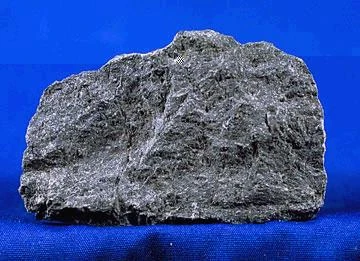
Hematite
Iron oxide mineral used as ore, pigment, and in jewelry.

Hematite (pronounced HE(E)M-ə-tyte, also haematite) is a common iron oxide with the chemical formula Fe2O3, found widely in rocks and soils. Its crystals belong to the rhombohedral lattice system and are the alpha polymorph of Fe2O3, sharing the same crystal structure as corundum (Al2O3) and ilmenite (FeTiO3). Naturally, hematite appears in colors ranging from black to steel or silver-gray, brown to reddish-brown, or red. It is mined as a major iron ore and is electrically conductive. Varieties include kidney ore, martite (pseudomorphs after magnetite), iron rose, and specularite (specular hematite). Despite their different forms, all varieties produce a rust-red streak. Hematite is harder than pure iron but much more brittle. The term "kidney ore" broadly describes botryoidal, mammillary, or reniform hematite. Maghemite (γ-Fe2O3) is a polymorph with the same chemical formula but a spinel structure like magnetite. Large hematite deposits occur in banded iron formations. Gray hematite typically forms in still, standing water or mineral hot springs, such as those in Yellowstone National Park, where it can precipitate and collect in layers at the bottom. Hematite can also form without water, usually from volcanic activity. Clay-sized hematite crystals may appear as a secondary mineral from weathering in soil, often alongside other iron oxides or oxyhydroxides like goethite, giving many tropical, ancient, or highly weathered soils their red color. The name comes from the Greek word for blood, αἷμα (haima), due to the red color in some varieties. Hematite has long been used as a pigment. The English name traces through Middle French *hématite pierre* and Latin *lapis haematites* (15th century), from Ancient Greek *αἱματίτης λίθος* (haimatitēs lithos, "blood-red stone"). Ochre is a clay colored by 20% to 70% hematite; red ochre contains unhydrated hematite, while yellow ochre contains hydrated hematite (Fe2O3 · H2O). Ochre’s main use is as a permanent tint. The mineral’s red chalk was used for writing, drawing, and decoration very early in human history. Hematite residues appear in grav
- chemical_formula
- Fe2O3
- crystal_system
- Rhombohedral (alpha polymorph of Fe2O3)
- color
- Black to steel or silver-gray, brown to reddish-brown, or red
- streak
- Rust-red
- hardness
- Harder than pure iron, but much more brittle
Lore & Background
Hematite occurs naturally in a variety of colors and forms, including kidney ore, martite, iron rose, and specularite. It is found in banded iron formations, near standing water or hot springs, and as a secondary mineral in weathered soils.
Reader's Guide
Hematite's significance spans multiple fields. As the primary ore of iron, it is economically vital for steel production. Its use as a pigment—in ochre, sienna, and umber—has been continuous from ancient cave paintings to modern industry, with India as the main producer. On Mars, hematite's detection by NASA spacecraft indicated past aqueous environments, guiding the Opportunity rover's exploration. In materials science, its magnetic properties, including antiferromagnetism and a Morin transition, are studied for nanoscale applications. Hematite is also used in jewelry, medical equipment, and coal production, though underground mining is classified as a carcinogenic hazard.
Did You Know?
- Hematite is electrically conductive.
- Hematite shows only a very feeble response to a magnetic field and is not noticeably attracted to an ordinary magnet.
- The spectral signature of hematite was seen on Mars, leading to the Opportunity rover's investigation of 'blueberries'—concretions formed from water.
Crystal Architecture and Mineral Varieties
Hematite is an iron oxide with the formula Fe2O3 that crystallizes in a rhombohedral lattice, making it the alpha polymorph of its chemical composition. The mineral is harder than pure iron yet considerably more brittle, and it conducts electricity. Its natural color palette spans black, steel-gray, silver-gray, brown, reddish-brown, and red, though every variety—kidney ore, martite, iron rose, and specularite—leaves the same rust-red streak when rubbed on a surface. Kidney ore is a broad descriptive term covering botryoidal, mammillary, or reniform growth forms. A closely related polymorph, maghemite (γ-Fe2O3), carries the identical chemical formula but adopts a spinel structure similar to that of magnetite. Hematite also sits within a complex oxyhydroxide solid-solution system in which varying water content, hydroxyl groups, and vacancy substitutions shift both the magnetic and crystal-chemical behavior of the mineral. Two additional end-members in this system are called protohematite and hydrohematite.
A Mineral Woven into Human History
The name hematite traces back to the Greek word for blood, haima, a nod to the deep red hues certain varieties display. Through Latin and Middle French the term settled into English as a reference to a blood-red stone. For tens of thousands of years this iron oxide has served as pigment and pigment carrier. Ochre clay, colored by between twenty and seventy percent hematite, comes in red (unhydrated) and yellow (hydrated) forms and has been prized for its permanent tint. On the island of Elba, rich deposits have been worked since Etruscan times. Yet underground hematite mining carries a serious occupational risk: it is classified as a carcinogenic hazard to workers.
The Puzzle of Hematite's Magnetism
Unlike its cousin magnetite, hematite barely responds to an ordinary magnet. The resolution: low symmetry at the cation sites lets spin–orbit coupling cant the moments when they lie in the plane perpendicular to the c-axis, while a shift in anisotropy at lower temperatures forces alignment along the c-axis, removing the energy advantage of canting. At the nanoscale the picture changes again—the Morin transition temperature drops as particle size shrinks, and impurities, trapped water, and lattice defects can suppress the transition altogether.
Where Hematite Forms and Persists
Hematite accumulates in large deposits within banded iron formations, one of the most distinctive geological archives on Earth. Gray hematite in particular tends to settle in still, standing water or mineral hot springs; a classic example is the layered deposits found in Yellowstone National Park, where the mineral precipitates from solution and collects in strata at the bottom of lakes and springs. The mineral can also form entirely in the absence of water, typically as a product of volcanic activity. At the clay scale, hematite crystals appear as a secondary mineral generated by weathering in soil. Alongside other iron oxides and oxyhydroxides such as goethite, it is responsible for the striking red coloration seen in many tropical, ancient, or heavily weathered soils. In the industrial aftermath of iron mining, hematite persists in waste tailings. A newer recovery technique called magnetation employs magnets to extract residual hematite from old tailings across Minnesota's Mesabi Range. In Sweden, tailings from the Falun Mine are processed into Falu red, a pigment still used in traditional house paints.
Frequently Asked Questions
What is Hematite?
Hematite is a widespread iron oxide mineral with the chemical formula Fe2O3, commonly encountered in rocks and soils around the world. It crystallizes in the rhombohedral system and is the alpha polymorph of iron(III) oxide.
What does Hematite look like?
Depending on its form, hematite can appear black, steel-gray, silver-gray, brown, reddish-brown, or bright red. Its streak is consistently rust-red, making it one of the most reliable field identification clues for this mineral.
What is Hematite used for?
It is mined primarily as a major iron ore, but it also serves as a pigment and a material for jewelry. Beyond metallurgy, hematite is electrically conductive, giving it additional industrial applications.
What are the main varieties of Hematite?
Common varieties include kidney ore, martite (a pseudomorph that forms after magnetite), iron rose, and specularite (specular hematite). Each variety reflects different formation conditions or crystal habits.
How does Hematite compare in hardness and structure to other minerals?
Hematite is harder than pure iron but is notably more brittle, so it tends to fracture rather than bend under stress. Its rhombohedral lattice is structurally related to corundum and ilmenite, which share the same crystal framework.
More in Rocks And Minerals 25-29
Elsewhere in the Rocks And Minerals universe
Spotted an error? Know more?
This is a living reference — every entry is fact-audited, and reader corrections feed straight into our audit queue. Suggest an edit · See this site's audit record