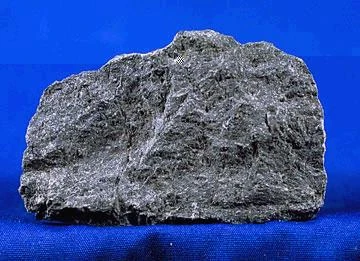
Epidote
A rock-forming sorosilicate mineral with strong pleochroism.

Epidote is a calcium aluminium iron sorosilicate mineral that crystallizes in the monoclinic system. It is an abundant rock-forming mineral of secondary origin, occurring in marble and schistose rocks of metamorphic origin, and is also a product of hydrothermal alteration of various minerals composing igneous rocks.
- chemical_formula
- Ca2Al2(Fe3+;Al)(SiO4)(Si2O7)O(OH)
- crystal_system
- Monoclinic
- color
- Green, grey, brown, or nearly black; usually pistachio-green
- pleochroism
- Strong; colors usually green, yellow, and brown
- specific_gravity
- Varies with iron content
- related_species
- Allanite, piemontite, dollaseite-(Ce)
Lore & Background
Well-developed crystals of epidote are commonly prismatic in habit, the direction of elongation being perpendicular to the single plane of symmetry. The name epidote is derived from the Greek word 'epidosis', meaning 'increase', in allusion to the crystal characteristic of one longer side at the base of the prism. The faces are often deeply striated and crystals are often twinned. Many characters of the mineral vary with the amount of iron present, including color, optical constants, and specific gravity. The color is usually a characteristic shade of yellowish-green or pistachio-green, and it displays strong pleochroism with green, yellow, and brown colors. Clinozoisite is a group species containing very little iron, having the same chemical composition as the orthorhombic mineral zoisite.
Reader's Guide
Epidote is significant as an abundant secondary mineral in metamorphic rocks and as a product of hydrothermal alteration. It occurs in marble and schistose rocks, and in rocks composed of quartz and epidote known as epidosite. Well-developed crystals are found at many localities, including Knappenwand near the Großvenediger in Salzburg, the Ala valley and Traversella in Piedmont, Arendal in Norway, Le Bourg-d'Oisans in Dauphiné, Haddam in Connecticut, and Prince of Wales Island in Alaska. Perfectly transparent, dark green crystals from the Knappenwand and from Brazil have occasionally been cut as gemstones. The green part of several mixed-rock ornamental stones, including Unakite and Australian Dragon Bloodstone, is composed of epidote. Related species in the same isomorphous group include the REE-rich allanite and the manganese-rich piemontite. Allanite is a primary accessory constituent of many crystalline rocks, while piemontite occurs as small, reddish-black crystals in manganese mines and crystalline schists.
Did You Know?
- The name epidote is derived from the Greek word 'epidosis', meaning 'increase', in allusion to one side of the ideal prism being longer than the other.
- Epidote displays strong pleochroism, with pleochroic colors usually being green, yellow, and brown.
- A rock composed of quartz and epidote is known as epidosite.
- The purple color of the Egyptian porfido rosso antico is due to the presence of piemontite, a related species.
Frequently Asked Questions
Who is Epidote?
Epidote is a calcium-aluminium-iron sorosilicate mineral that crystallizes in the monoclinic system. It is most widely recognized by its signature pistachio-green hue, though specimens can also present as grey, brown, or nearly black.
What are Epidote's powers or defining traits?
Epidote exhibits strong pleochroism, revealing distinctly different colors—typically green, yellow, and brown—depending on the crystallographic direction you observe it from. Its specific gravity also shifts in tandem with its iron content, giving each specimen a slightly different density.
Where does Epidote appear in the rock canon?
It is an abundant secondary-phase mineral most at home in metamorphic settings such as marble and schistose rocks. It also shows up as a hydrothermal-alteration product within igneous rocks, making it a reliable supporting character across both geological backstories.
How does Epidote's arc conclude?
Because Epidote forms as a later-stage alteration product rather than a primary crystallization, it represents a relatively stable endpoint in many rock-formation sequences. It sits alongside close relatives like allanite, piemontite, and dollaseite-(Ce) in the broader sorosilicate family tree.
Why is Epidote important to the mineral community?
Geologists rely on Epidote's presence to fingerprint metamorphic and hydrothermal environments, since its formation is tightly linked to specific pressure-temperature and fluid conditions. Its diagnostic chemistry, Ca₂Al₂(Fe³⁺;Al)(SiO₄)(Si₂O₇)O(OH), makes it a go-to indicator for reconstructing the history of the host rock.
More in Rocks And Minerals 1-24
Elsewhere in the Rocks And Minerals universe
Spotted an error? Know more?
This is a living reference — every entry is fact-audited, and reader corrections feed straight into our audit queue. Suggest an edit · See this site's audit record