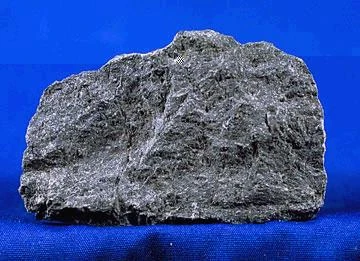
Diorite
An intrusive igneous rock intermediate between gabbro and granite.

Diorite is an intrusive igneous rock formed by the slow cooling underground of magma with moderate silica content and relatively low alkali metals. It is intermediate in composition between low-silica gabbro and high-silica granite, and is found in mountain-building belts on continental margins.
- type
- Intrusive igneous rock
- composition
- Intermediate between mafic gabbro and felsic granite
- mineral_content
- Plagioclase feldspar (typically andesine), biotite, hornblende, sometimes pyroxene
- volcanic_equivalent
- Andesite
- distinguishing_feature
- Plagioclase richer in sodium and poorer in calcium than gabbro
- typical_mafic_content
- Less than 35% mafic minerals
- first_named_by
- René Just Haüy
Lore & Background
Diorite results from the partial melting of mafic rock above a subduction zone and is found in volcanic arcs and cordilleran mountain building, such as the Andes. While its extrusive equivalent andesite is common, diorite is a minor component of plutonic rocks, which are mostly granodiorite or granite. Diorite also makes up some stocks intruded beneath large calderas. Source localities include Leicestershire and Aberdeenshire, UK; Thuringia and Saxony in Germany; Finland; Romania; central Sweden; southern Vancouver Island; the Darran Range of New Zealand; the Andes; and Concordia in South Africa. Hornblende diorite is common in the Henry, Abajo, and La Sal Mountains of Utah, where it was emplaced as laccoliths.
Reader's Guide
Human use of diorite dates at least to the Middle Neolithic, when it was used in a passage grave at Le Dolmen du Mont Ubé, Jersey. The Akkadian Empire of Sargon of Akkad used diorite for funerary sculptures after sources came under their control. Diorite was used to depict rulers or high officials in ceremonial poses or attitudes of prayer. The Inca civilization used diorite as structural stone, and medieval Islamic builders used it for water fountains in the Crimea. In later times, diorite was commonly used as cobblestone; many diorite cobblestone streets remain in England and Guernsey. Guernsey diorite was used in the steps of St Paul's Cathedral, London. Today, diorite is often sold commercially as 'black granite' and used for construction aggregate, curbing, dimension stones, cobblestone, and facing stones.
Did You Know?
- Diorite was first named by René Just Haüy from Ancient Greek διορίζειν, 'to distinguish', due to its easily identifiable large hornblende crystals.
- Orbicular diorite shows alternating concentric growth bands of plagioclase and amphibole surrounding a nucleus within a diorite porphyry matrix.
- A ferrodiorite is a dioritoid enriched in iron and titanium, common in the lower oceanic crust.
Frequently Asked Questions
What is Diorite?
Diorite is an intrusive igneous rock that forms when magma cools slowly deep underground. It sits in the middle of the silica spectrum, between the more mafic gabbro and the more felsic granite.
What minerals make up Diorite?
The main components are plagioclase feldspar (usually andesine), biotite, and hornblende, with occasional pyroxene. Mafic minerals account for less than 35% of the total rock volume.
How do you tell Diorite apart from Gabbro?
The key difference lies in the plagioclase feldspar: in diorite it is richer in sodium and poorer in calcium compared to the plagioclase found in gabbro. Diorite also has a lower overall mafic mineral content, staying under 35%.
What is Diorite's volcanic equivalent?
Andesite is the extrusive counterpart to diorite, forming when similar intermediate-composition magma erupts at the surface rather than cooling slowly underground.
Where is Diorite typically found?
It occurs in mountain-building belts along continental margins, where tectonic activity drives magma intrusion at depth.
More in Rocks And Minerals 1-24
Elsewhere in the Rocks And Minerals universe
Spotted an error? Know more?
This is a living reference — every entry is fact-audited, and reader corrections feed straight into our audit queue. Suggest an edit · See this site's audit record