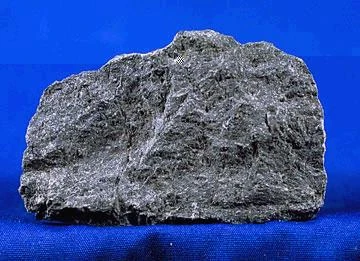
Hornfels
Baked, hard, fine-grained contact metamorphic rock named for horn-like toughness.

Hornfels is the group name for a set of contact metamorphic rocks that have been baked and hardened by the heat of intrusive igneous masses. They are massive, hard, splintery, and in some cases exceedingly tough and durable, with properties caused by fine-grained non-aligned crystals with platy or prismatic habits. The term is derived from the German word Hornfels, meaning 'hornstone', because of their exceptional toughness and texture reminiscent of animal horns.
- type
- Contact metamorphic rock group
- named_from
- German 'Hornfels' (hornstone)
- key_properties
- Massive, hard, splintery, tough, durable
- common_colors
- Dark-brown to black (biotite hornfels); white, yellow, pale-green, brown (lime hornfels); green and dark-green (from igneous rocks)
- typical_origin
- Aureole of granitic intrusions in upper or middle crust
- metamorphic_facies
- Hornfels facies (lowest pressure portion of metamorphic pressure-temperature space)
Lore & Background
Hornfels form when original rocks such as sandstone, shale, slate, and limestone are baked by the heat of intrusive igneous masses. The original bedding or cleavage planes are effaced or rendered inoperative, and the rock breaks across them as readily as along them, tending to separate into cubical fragments. Sheet minerals may be abundant but are aligned at random. Most hornfels are fine-grained, though larger crystals (porphyroblasts) of cordierite, garnet, or andalusite may be scattered through the fine matrix and become prominent on weathered faces.
Reader's Guide
Hornfels are significant as a key product of contact metamorphism, illustrating how heat from igneous intrusions can transform sedimentary and igneous rocks without large-scale deformation. Their fine-grained, mosaic-like pavement structure and lack of aligned crystals distinguish them from schists and gneisses. The hornfels facies occupies the lowest pressure portion of metamorphic pressure-temperature space, subdivided into low-temperature regimes. The rocks show a range of compositions: pelitic hornfels (biotite, andalusite, sillimanite, cordierite), calc-silicate hornfels from impure limestones (diopside, epidote, garnet), and mafic hornfels from igneous rocks (feldspar, hornblende, pyroxene). There is dispute over whether chemical changes (metasomatism) are significant; most authorities regard the changes as purely physical. Hornfels were historically used as whetstones by miners in northern England.
Did You Know?
- The term 'hornfels' comes from the German word for 'hornstone', due to its toughness and texture like animal horns.
- Miners in northern England referred to these rocks as whetstones.
- Hornfels often contain porphyroblasts of cordierite, garnet, or andalusite visible on weathered surfaces.
- The hornfels facies is the metamorphic facies occupying the lowest pressure portion of metamorphic pressure-temperature space.
Frequently Asked Questions
What is Hornfels?
Hornfels is a group of contact metamorphic rocks produced when surrounding country rock is heated and recrystallized by the intrusion of molten igneous material. The result is a massive, hard, and splintery rock whose very fine, non-aligned crystals give it a distinctive toughness.
Why is it called 'Hornfels'?
The name is a direct borrowing from the German word meaning 'hornstone,' a nod to the rock's remarkable toughness and the way its texture evokes animal horn. Early German geologists coined the term to capture that horn-like hardness.
How does Hornfels form?
It develops in the heated aureole around granitic or other intrusive igneous bodies in the middle to upper crust, where intense heat but relatively low pressure recrystallizes the host rock without producing aligned foliation. This places it squarely in the hornfels facies, the lowest-pressure corner of metamorphic pressure-temperature space.
What does Hornfels look like?
Color depends on the parent rock: biotite hornfels runs dark-brown to black, lime hornfels appears white, yellow, pale-green, or brown, and varieties derived from igneous protoliths tend toward green or dark-green. In all cases the crystals are fine-grained and platy or prismatic, giving the rock a splintery, hard hand-feel.
What sets Hornfels apart from other metamorphic rocks like schist or gneiss?
Hornfels lacks the banded, aligned foliation typical of schists and gneisses because it forms under high heat but low directed pressure. Its randomly oriented, fine crystals make it exceptionally tough and durable—exactly the quality that led early geologists to compare it to horn.
More in Rocks And Minerals 1-24
Elsewhere in the Rocks And Minerals universe
Spotted an error? Know more?
This is a living reference — every entry is fact-audited, and reader corrections feed straight into our audit queue. Suggest an edit · See this site's audit record