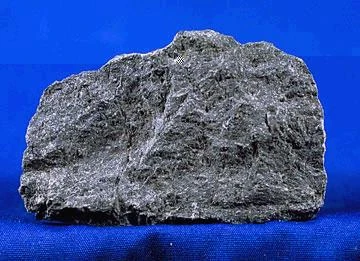
Greenschist
A green, foliated metamorphic rock from low-grade regional metamorphism.

It is defined by the presence of green minerals such as chlorite, epidote, and actinolite, and exhibits pronounced schistosity, a thin layering that allows the rock to split into flakes or slabs. Greenschist is a general field term for metamorphosed mafic volcanic rock, derived from basalt, gabbro, or similar rocks.
- type
- Metamorphic rock
- key_minerals
- Chlorite, epidote, actinolite, albite
- facies
- Greenschist facies (low temperature, moderate pressure)
- common_protoliths
- Basalt, gabbro, mafic volcanic rock
Lore & Background
The equilibrium mineral assemblage depends on the original rock composition: basalt yields chlorite, actinolite, albite, and sometimes epidote; ultramafic rocks produce chlorite, serpentine, talc, and other minerals; pelites yield quartz, albite, chlorite, muscovite, and garnet; calc-silicates produce calcite, dolomite, and quartz. The facies is subdivided into subgreenschist, lower, and upper greenschist, with transitions to prehnite-pumpellyite and amphibolite facies.
Reader's Guide
Greenschist is significant as a key indicator of low-grade regional metamorphism and is used to define the greenschist facies, a critical part of the Barrovian metamorphic sequence. In eastern North America, chlorite schist was used by prehistoric Native American communities for axes, celts, and ornamental items, and was traded over thousands of kilometers during the Hopewell culture exchange network. During the Mississippian culture, the polity of Moundville controlled production and distribution of greenschist from two localities in the Hillabee Formation of Alabama. The rock also appears in Archean greenstone belts, which host ore deposits in Australia, Namibia, and Canada.
Did You Know?
- Greenschist is defined by the presence of chlorite, epidote, or actinolite, which give the rock its green color.
- Greenschist facies conditions typically occur at depths of about 8 to 50 kilometers.
- The Moundville polity in the Mississippian culture controlled greenschist production from two localities in the Hillabee Formation of Alabama.
Formation & Defining Mineralogy
Its identity rests on a characteristic suite of green minerals—chlorite, epidote, and actinolite—often accompanied by platy varieties of muscovite and serpentine. These flat, plate-like crystals align during metamorphism to produce schistosity, the rock's signature tendency to cleave into thin flakes or slabs no thicker than five to ten millimeters. Beyond the defining green assemblage, greenschist commonly hosts quartz, orthoclase, talc, carbonate minerals, and albite. The protolith is usually a mafic volcanic or intrusive rock such as basalt or gabbro, one rich in sodium-bearing plagioclase feldspar. Crucially, to earn the name greenschist rather than the broader field term greenstone, the rock must display visible foliation or layering. Texture is typically lepidoblastic, nematoblastic, or schistose, and grain size remains fine because chlorite and actinolite grow in small, flat or needle-like crystal habits rather than large grains.
The Greenschist Facies in Metamorphic Context
Within the broader Barrovian Facies Sequence and the lower-pressure Abukuma Facies Series, greenschist sits at the lower-temperature end. It is further subdivided into subgreenschist, lower greenschist, and upper greenschist, with the coldest conditions overlapping the prehnite-pumpellyite facies and the warmest bleeding into sub-amphibolite territory. If burial and heating continue along Barrovian trajectories, greenschist assemblages give way to amphibolite-facies minerals and eventually granulite-facies rocks. At lower pressures, contact metamorphism yields albite-epidote hornfels, while extreme depth produces eclogite. The equilibrium assemblage also shifts with protolith: ultramafic rocks generate chlorite-serpentine-talc suites, pelites yield quartz-mica-garnet combinations, and calc-silicates produce calcite-dolomite-quartz assemblages. Notably, greenschist-like mineralogy can emerge even under blueschist-facies conditions when the original rock carries sufficient magnesium, a factor that helps explain why true blueschist is scarce in the geological record before the Neoproterozoic Era, when oceanic crust was richer in magnesium.
Cultural Heritage & Prehistoric Trade
Long before modern geology named them, greenschist rocks shaped human material culture across continents. Across Europe, the same green stone was worked into axes, with Great Langdale in England recognized as a notable source. In eastern North America, a chlorite-rich schist became prized among prehistoric Native American communities for crafting axes, celts, and ornamental pieces. During the Middle Woodland period, greenschist entered the vast Hopewell exchange network, moving as a trade commodity over distances of thousands of kilometers. By the Mississippian era, the polity centered at Moundville appears to have exercised control over both the production and distribution of the stone, with sourcing traced to two localities within the Hillabee Formation of central and eastern Alabama. These examples illustrate how a single metamorphic rock type could serve as pavement, tool, ornament, and currency of prestige across geographically and culturally diverse societies.
Geological Significance & Economic Legacy
Beyond its mineralogical definition, greenschist holds a distinctive place in Earth's deep-time record. The greenstone belts of Archean cratons—ancient stable cores of continental crust—are commonly altered to the greenschist facies and are recognized as host rocks for a variety of ore deposits across Australia, Namibia, and Canada. Near mid-ocean ridges today, oceanic basalts typically display only sub-greenschist alteration, preserving a snapshot of the earliest stages of seafloor metamorphism. The term greenstone itself stretches well beyond strict petrology: in Scotland it has been applied to igneous intrusions cutting the Coal Measures Group, in Great Britain to chamosite-rich mudstones of Early Jurassic age, and even to nephrite and other greenish gemstones. Pounamu, a rock frequently labeled greenstone in New Zealand, belongs to a separate mineralogical family. The interplay between greenschist and blueschist facies also carries a profound implication for deep geological history: because ancient oceanic crust contained more magnesium than its modern counterpart, blueschist-facies conditions could produce greenschist-like assemblages, partially explaining the paucity of preserved blueschist older than roughly one billion years.
Frequently Asked Questions
What is Greenschist?
Greenschist is a green, foliated metamorphic rock produced by low-grade regional metamorphism. Its name reflects both its characteristic color and its schistose texture, which lets it break into thin slabs.
What minerals make up Greenschist?
The defining green minerals are chlorite, epidote, and actinolite, with albite also commonly present. Together they give the rock its distinctive hue and flaky layered appearance.
What protoliths form Greenschist?
It most often develops from mafic rocks such as basalt or gabbro. These volcanic or intrusive parent rocks are transformed under moderate pressure and low temperature into the green, layered rock we recognize as greenschist.
Under what conditions does Greenschist form?
Greenschist is the signature rock of the greenschist facies, representing low-temperature, moderate-pressure metamorphism. These conditions are typical of shallow subduction settings or the outer zones of continental collision belts.
What is schistosity in Greenschist?
Schistosity is the pronounced thin layering that allows the rock to split into flakes or slabs along parallel planes. It results from the alignment of platy green minerals like chlorite during directed pressure.
More in Rocks And Minerals 1-24
Elsewhere in the Rocks And Minerals universe
Spotted an error? Know more?
This is a living reference — every entry is fact-audited, and reader corrections feed straight into our audit queue. Suggest an edit · See this site's audit record