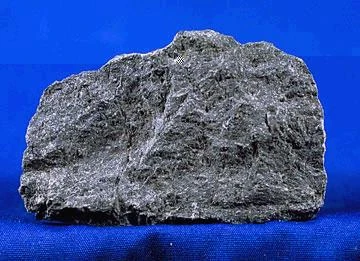
Hornblende
A dark amphibole mineral series common in igneous and metamorphic rocks.

Hornblende is a complex inosilicate series of minerals, not a recognized mineral in its own right, but used as a general or field term to refer to a dark amphibole. It is common in igneous and metamorphic rocks and is highly variable in composition, encompassing at least five solid solution series.
- hardness
- 5–6
- specific_gravity
- 3.0 to 3.6
- color
- opaque green, dark green, brown, or black
- crystal_habit
- slender prismatic to bladed crystals, diamond-shaped in cross section, or irregular grains or fibrous masses
- formula
- (Ca,Na)2−3(Mg,Fe,Al)5(Al,Si)8O22(OH,F)2
Lore & Background
Hornblende is part of the calcium-amphibole group and includes solid solution series such as magnesiohornblende–ferrohornblende, tschermakite–ferrotschermakite, edenite–ferroedenite, pargasite–ferropargasite, and magnesiohastingstite–hastingsite. Different chemical types are almost impossible to distinguish even by optical or X-ray methods, requiring detailed chemical analysis using an electron microprobe. There is a solid solution series between hornblende and tremolite–actinolite at elevated temperature, but a miscibility gap exists at lower temperatures, often resulting in exsolution lamellae of grunerite. Hornblende is a common constituent of many igneous and metamorphic rocks such as granite, syenite, diorite, gabbro, basalt, andesite, gneiss, and schist. It crystallizes in preference to pyroxene minerals from cooler magma richer in silica and water. It is the principal mineral of amphibolites, which form during medium- to high-grade metamorphism of mafic to intermediate igneous rock in the presence of pore water. Hornblende alters easily to chlorite, biotite, or other mafic minerals. A rare variety of hornblende contains less than 5% iron oxide, is gray to white, and is named edenite from its locality in Edenville, Orange County, New York. Oxyhornblende is a variety in which most iron has been oxidized to the ferric state, enriched in titanium, found almost exclusively in volcanic rock, and sometimes called basaltic hornblende.
Reader's Guide
Hornblende is significant as a widespread and compositionally complex mineral series that serves as a key indicator in petrology for understanding the conditions of igneous and metamorphic rock formation. Its presence in rocks such as granite, basalt, and amphibolite helps geologists infer the cooling history, water content, and silica saturation of magmas, as well as the metamorphic grade of host rocks. The mineral's high variability in composition, including substitutions of titanium, manganese, chromium, and halogens, makes it a valuable subject for geochemical studies using electron microprobe analysis. Hornblende's tendency to alter to chlorite or biotite provides clues about retrograde metamorphic processes. The term 'hornblende' itself, derived from German words meaning 'horn' and 'deceive,' reflects its historical confusion with metal-bearing ores. Overall, hornblende is a fundamental mineral for interpreting the petrogenesis of many common rock types.
Did You Know?
- Hornblende is not a recognized mineral in its own right but a general term for a dark amphibole.
- A rare variety of hornblende containing less than 5% iron oxide is gray to white and named edenite from Edenville, Orange County, New York.
- Oxyhornblende is a variety enriched in titanium, found almost exclusively in volcanic rock, and sometimes called basaltic hornblende.
Frequently Asked Questions
Who is Hornblende?
Hornblende is not a single named mineral but a broad family of dark amphibole minerals lumped together under one general field term. It represents a complex inosilicate series that spans at least five distinct solid-solution end-members.
What are Hornblende's powers and role?
It registers a hardness of 5 to 6 on the Mohs scale and a specific gravity between 3.0 and 3.6, appearing in shades of opaque green, dark green, brown, or black. Its crystals typically grow as slender prisms or blades showing a diamond-shaped cross-section, though it can also occur as irregular grains or fibrous masses.
How does Hornblende's story end?
Hornblende is most commonly encountered as a constituent of both igneous and metamorphic rock formations. Rather than a single narrative arc, it persists as a widespread framework or accessory mineral throughout those rock types.
Why is Hornblende important to the series?
Because its composition is highly variable—swapping calcium, sodium, magnesium, iron, and aluminum in and out of the lattice—it serves as a useful geochemical indicator of the conditions under which a rock formed. Petrologists rely on its chemistry to reconstruct the temperature and pressure histories of igneous and metamorphic environments.
What is Hornblende's chemical formula?
The general formula is written as (Ca,Na)2-3(Mg,Fe,Al)5(Al,Si)8O22(OH,F)2, reflecting the wide range of cations and anions that can occupy its structural sites. This compositional flexibility is precisely why it is treated as a mineral series rather than a single discrete species.
More in Rocks And Minerals 1-24
Elsewhere in the Rocks And Minerals universe
Spotted an error? Know more?
This is a living reference — every entry is fact-audited, and reader corrections feed straight into our audit queue. Suggest an edit · See this site's audit record