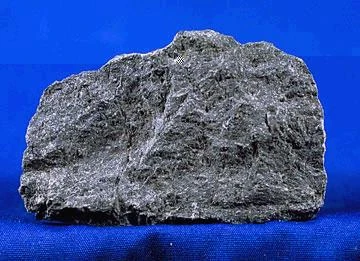
Diopside
A pyroxene mineral found in mantle rocks and used as a diamond indicator.

Diopside is a mineral from the pyroxene group, with a monoclinic crystal structure and the chemical formula MgCaSi2O6. It can form a complete solid solution series with hedenbergite and augite, and partial solid solutions with orthopyroxene and pigeonite. Its crystals are typically a dull green, though colors vary, and they belong to the monoclinic prismatic class. Like other pyroxenes, it has two distinct prismatic cleavages at angles of 87° and 93°. It ranks six on the Mohs hardness scale, has a Vickers hardness of 7.7 GPa under a 0.98 N load, and a specific gravity ranging from 3.25 to 3.55. Diopside occurs in ultramafic igneous rocks like kimberlite and peridotite, and diopside-rich augite is common in mafic rocks such as olivine basalt and andesite. It is also found in metamorphic settings, particularly in contact metamorphosed skarns derived from high-silica dolomites. The mineral is significant in the Earth’s mantle and appears frequently in peridotite xenoliths brought up by kimberlite and alkali basalt eruptions. Through hydrothermal alteration and magmatic differentiation, diopside can act as a precursor to chrysotile (white asbestos); it may react with hydrous magnesium and chlorine solutions when heated to form chrysotile. Some vermiculite deposits, notably those near Libby, Montana, contain chrysotile and other asbestos forms that originated from diopside. At high temperatures, a miscibility gap exists between diopside and pigeonite, and at lower temperatures, between diopside and orthopyroxene. Chrome diopside, with the formula Ca(Mg,Cr)Si2O6, is a common component of peridotite xenoliths. Scattered grains near kimberlite pipes serve as a prospecting indicator for diamonds. It has been reported in Canada, South Africa, Russia, Brazil, and many other locations. In the United States, chromian diopside occurs in the serpentinite belt of northern California, in kimberlite in the Colorado-Wyoming State Line district and the Iron Mountain district o
- composition
- MgCaSi2O6
- crystal_system
- Monoclinic prismatic
- hardness
- Mohs 6; Vickers 7.7 GPa at 0.98 N
- specific_gravity
- 3.25 to 3.55
- optic_angle
- 58° to 63°
- cleavage
- Two distinct prismatic cleavages at 87° and 93°
Lore & Background
Diopside derives its name from the Greek dis, 'twice', and òpsè, 'face' in reference to the two ways of orienting the vertical prism. The mineral forms variably colored, typically dull green crystals and is transparent to translucent.
Reader's Guide
Diopside is significant as a rock-forming mineral in ultramafic and mafic igneous rocks, as well as in metamorphic skarns. Chrome diopside serves as a prospecting indicator for diamonds, with occurrences in Canada, South Africa, Russia, Brazil, and the US. Gem-quality diopside includes black star diopside and chrome diopside, the latter sometimes called 'Siberian emerald' though unrelated to emerald. Diopside-based ceramics and glass-ceramics have potential applications in biomaterials, nuclear waste immobilization, and solid oxide fuel cell sealants. The mineral is also a precursor to chrysotile asbestos via hydrothermal alteration.
Did You Know?
- Diopside forms complete solid solution series with hedenbergite and augite.
- Chrome diopside is a prospecting indicator for diamonds.
- Diopside-based glass-ceramic 'silceram' was produced from blast furnace slag during the 1980s.
Frequently Asked Questions
What is diopside?
Diopside is a member of the pyroxene mineral family with the chemical formula MgCaSi2O6. It crystallizes in the monoclinic prismatic system and is one of the more recognizable single-component pyroxenes.
What does diopside look like in hand specimen?
Crystals are most commonly a muted, dull green, though other hues are possible. They display two clearly distinct prismatic cleavage directions that intersect at roughly 87° and 93°, a hallmark shared across the pyroxene group.
How hard is diopside and how does it compare to common minerals?
It sits at 6 on the Mohs scale, making it slightly harder than orthoclase feldspar but softer than quartz. Under a Vickers micro-indentation test at 0.98 N it registers about 7.7 GPa, and its specific gravity falls between 3.25 and 3.55.
Where is diopside typically found and why do geologists care about it?
It occurs in mantle-derived rocks such as eclogites and peridotites. Because it is a common constituent of diamond-bearing kimberlite assemblages, prospectors and geologists use its presence as a practical indicator that diamonds may be nearby.
How does diopside fit into the broader pyroxene solid-solution series?
It forms a complete solid-solution range with hedenbergite and augite, meaning its composition can shift continuously between those end-members. It also shows partial solid-solution behavior with orthopyroxene and pigeonite, blurring the boundaries between single- and multi-component pyroxenes.
More in Rocks And Minerals 1-24
Elsewhere in the Rocks And Minerals universe
Spotted an error? Know more?
This is a living reference — every entry is fact-audited, and reader corrections feed straight into our audit queue. Suggest an edit · See this site's audit record