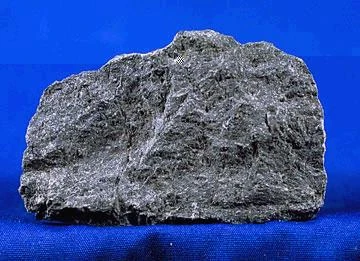
Dacite
Intermediate volcanic rock between andesite and rhyolite.

Dacite is a fine-grained volcanic rock that forms when lava rich in silica but low in alkali metal oxides cools quickly. Its texture ranges from aphanitic to porphyritic, and it sits compositionally between andesite and rhyolite. The rock is fairly widespread, appearing in many tectonic environments, and it belongs to the subalkaline tholeiitic and calc-alkaline magma series, often found alongside andesite and rhyolite. The name dacite comes from Dacia, a Roman province between the Danube and the Carpathians (modern Romania and Moldova), where the rock was first described. Austrian geologists Franz Ritter von Hauer and Guido Stache introduced the term in their book *Geologie Siebenbürgens* (The Geology of Transylvania). They originally defined dacite to distinguish calc-alkaline rocks containing oligoclase phenocrysts from rhyolites, which have orthoclase phenocrysts. In terms of composition, dacite is made mostly of plagioclase feldspar and quartz, along with biotite, hornblende, and pyroxene (either augite or enstatite). Quartz appears as rounded, corroded phenocrysts or as part of the groundmass. The plagioclase ranges from oligoclase to andesine and labradorite. Some dacites contain small amounts of sanidine; when sanidine is abundant, the rock grades into rhyolite. The QAPF diagram shows the relative proportions of feldspars and quartz, defining dacite as having 20% to 60% quartz, with plagioclase making up at least 65% of the feldspar content. However, because dacites are often too fine-grained for mineral identification, the IUGS allows chemical classification based on silica and alkali metal oxide content, placing dacite in the O3 sector of the TAS diagram. In hand specimens, hornblende and biotite dacites are typically grey, pale brown, or yellow, with white feldspars and black crystals of biotite and hornblende. Pyroxene-bearing dacites tend to be darker. Under a microscope, dacites show aphanitic to porphyritic textures. Porphyritic varieties contain blocky, highly zoned plagioclase phenocrysts and rounded, corroded quartz phenocrysts. Subhedral hornblende and elongated biotite grains are common, and some samples include sanidine phenocrysts and augite or enstatite. The groundmass is often aphanitic and microcrystalline, with tiny feldspars mixed with interstitial quartz or tridymite; in many dacites, it is largely glassy, while in others it is
- type
- Volcanic rock
- composition
- Plagioclase feldspar and quartz, with biotite, hornblende, and pyroxene
- texture
- Aphanitic to porphyritic
- silica_content
- High
- alkali_content
- Low alkali metal oxides
- first_described_in
- Geologie Siebenbürgens (The Geology of Transylvania)
- type_locality
- Gizella quarry near Poieni, Cluj, Romania
Lore & Background
The word dacite comes from Dacia, a province of the Roman Empire between the Danube River and Carpathian Mountains (now modern Romania and Moldova), where the rock was first described. The term was used for the first time in the scientific literature in the book Geologie Siebenbürgens by Austrian geologists Franz Ritter von Hauer and Guido Stache. Dacite was originally defined to separate calc-alkaline rocks with oligoclase phenocrysts from rocks with orthoclase phenocrysts (rhyolites). Dacite consists mostly of plagioclase feldspar and quartz with biotite, hornblende, and pyroxene. The quartz appears as rounded, corroded phenocrysts or as an element of the groundmass. The plagioclase ranges from oligoclase to andesine and labradorite. Sanidine occurs in small proportions in some dacites, and when abundant gives rise to transitions to rhyolites. The relative proportions of feldspars and quartz are illustrated in the QAPF diagram, which defines dacite as having 20% to 60% quartz, with plagioclase making up 65% or more of its feldspar content. In hand specimen, many hornblende and biotite dacites are grey or pale brown and yellow rocks with white feldspars and black crystals of biotite and hornblende. Pyroxene-bearing dacites are darker colored. In thin section, dacites may have an aphanitic to porphyritic texture, with blocky highly zoned plagioclase phenocrysts and/or rounded corroded quartz phenocrysts. The groundmass is often aphanitic microcrystalline, but in many dacites it is largely vitreous, felsitic, or cryptocrystalline.
Reader's Guide
Dacite usually forms as an intrusive rock such as a dike or sill, but because of its moderately high silica content, dacitic magma is quite viscous and prone to explosive eruption. A notorious example is Mount St. Helens, where dacite domes formed from previous eruptions. Pyroclastic flows may also be of dacitic composition, as with the Fish Canyon Tuff of La Garita Caldera. Dacitic magma is formed by the subduction of young oceanic crust under a thick felsic continental plate, where the subducted slab partially melts and interacts with the upper mantle. The formation of dacite provides a model for the generation of felsic, buoyant, perennial rock from a mafic, dense, short-lived one, and has been used to explain the generation of continental crust during the Archean eon. Dacite is relatively common and occurs in various tectonic settings, including oceanic volcanic series, subduction zones of island arcs and active continental margins, and continental volcanic series. It is found on Earth in locations such as Romania, Germany, Greece, Italy, Austria, Scotland, Slovakia, Spain, France, Hungary, Iran, Morocco, New Zealand, Turkey, the United States, and Zambia, and extraterrestrially at Nili Patera caldera of Syrtis Major Planum on Mars.
Did You Know?
- The word dacite comes from Dacia, a Roman province between the Danube River and Carpathian Mountains.
- Dacite was first described in the book Geologie Siebenbürgens by Austrian geologists Franz Ritter von Hauer and Guido Stache.
- Dacite is found extraterrestrially at Nili Patera caldera of Syrtis Major Planum on Mars.
Etymology & Scientific Origins
The name dacite traces back to Dacia, an ancient Roman province stretching between the Danube River and the Carpathian Mountains, encompassing what is now Romania and Moldova. It was in this region that the rock first received formal scientific attention. Austrian geologists Franz Ritter von Hauer and Guido Stache introduced the term in their publication Geologie Siebenbürgens (The Geology of Transylvania), where they needed a way to distinguish calc-alkaline rocks bearing oligoclase phenocrysts from those carrying orthoclase phenocrysts—the latter already known as rhyolites. By coining dacite, they created a new category that cleanly separated these two rock families based on their feldspar character. The type locality, a quarry called Gizella near Poieni in Cluj, Romania, anchors the rock's identity to this specific European landscape. The naming convention reflects a broader tradition in geology where new rock types are tied to the place of their first recognition, preserving a geographic memory within scientific vocabulary.
Mineral Composition & Classification Challenges
Dacite's mineral assemblage centers on plagioclase feldspar and quartz, supplemented by biotite, hornblende, and pyroxene minerals such as augite or enstatite. The plagioclase spans a range from oligoclase through andesine to labradorite, while quartz appears either as rounded, corroded phenocrysts or dispersed within the groundmass. In some samples, sanidine occurs in small quantities, and when it becomes abundant the rock transitions toward rhyolite. The QAPF diagram formalizes dacite's position by requiring 20 to 60 percent quartz and plagioclase constituting at least 65 percent of total feldspar. However, classification presents a practical difficulty: many dacites are so fine-grained that identifying individual minerals becomes impractical. In such cases, geologists turn to chemical analysis, measuring silica and alkali metal oxide content. The TAS classification system places dacite in the O3 sector, reflecting its intermediate silica-alkali character. This dual approach—mineralogical when feasible, chemical when necessary—underscores the complexity of categorizing a rock whose texture often resists straightforward identification.
Formation & the Subduction Engine
Dacitic magma is generated through the subduction of young oceanic crust beneath a thick felsic continental plate. The oceanic slab, already hydrothermally altered to carry added quartz and sodium, descends into the mantle where convection and dehydration reactions trigger partial melting. Minerals like talc, serpentine, mica, and amphiboles break down, releasing a more sodic melt. As this magma migrates upward, ongoing differentiation makes it progressively more sodic and silicic. Upon reaching the cold surface, it crystallizes plagioclase, quartz, and hornblende, with accessory pyroxenes preserving clues to the magma's journey. Because of its moderately high silica content, dacitic magma is viscous and prone to explosive eruption—Mount St. Helens, where dacite domes formed from earlier eruptions, being a notorious example. The broader significance lies in what dacite reveals about the transformation of dense, mafic oceanic material into buoyant, felsic continental rock. During the Archean eon, when oceanic crust was younger and hotter, this process was far more widespread, helping build the early continental crust.
Global Distribution & Tectonic Settings
Dacite is a geographically widespread rock, appearing across diverse tectonic environments. In oceanic volcanic series, it crops out along the Heiðarsporður ridge in Iceland and the Juan de Fuca Ridge. In subduction-zone settings, it is a hallmark of both island arcs and active continental margins. Island arc examples span Japan, the Philippines, the Aleutians, the Antilles, the Sunda Arc (notably Mount Batur), Tonga, and the South Sandwich Islands. Active continental margins hosting dacitic magmatism include the Cascade Range, Guatemala, and the Andes across Ecuador, Peru, and Chile. In continental volcanic series, dacite often accompanies tholeiitic basalts and intermediate rocks. European occurrences extend beyond the Romanian type locality to Germany's Weiselberg, Greece's Nisyros and Thera, Italy's Bozen quartz porphyry and Sardinia, and Austria's Styrian Volcano Arc. This broad distribution across oceanic, arc, and continental settings confirms dacite's association with both subalkaline tholeiitic and calc-alkaline magma series, making it a versatile tracer of magmatic processes worldwide.
Frequently Asked Questions
What is Dacite?
Dacite is a fine-grained volcanic rock produced when silica-rich, low-alkali lava cools quickly at or near the surface. It is classified as an intermediate rock, sitting compositionally between andesite and rhyolite.
What minerals make up Dacite?
Its main constituents are plagioclase feldspar and quartz, with biotite, hornblende, or pyroxene appearing as secondary phases. The high silica content paired with low alkali metal oxides is what sets it apart from more mafic volcanic rocks.
Where does the name Dacite come from?
The name traces back to Dacia, a Roman province stretching between the Danube and the Carpathian Mountains in present-day Romania and Moldova. The rock was first formally described in a geological survey of Transylvania authored by Austrian geologists.
How does Dacite compare to andesite and rhyolite?
Dacite occupies the middle ground in silica content, being richer in silica than andesite but less so than rhyolite. All three share the subalkaline tholeiitic and calc-alkaline magma series and are commonly found together in the same volcanic sequences.
What texture does Dacite have and where is it found?
It typically shows an aphanitic to porphyritic texture, ranging from a uniformly fine groundmass to one with scattered larger phenocrysts. Dacite is fairly widespread, appearing across a variety of tectonic settings and often occurring alongside its andesite and rhyolite neighbors.
More in Rocks And Minerals 1-24
Elsewhere in the Rocks And Minerals universe
Spotted an error? Know more?
This is a living reference — every entry is fact-audited, and reader corrections feed straight into our audit queue. Suggest an edit · See this site's audit record