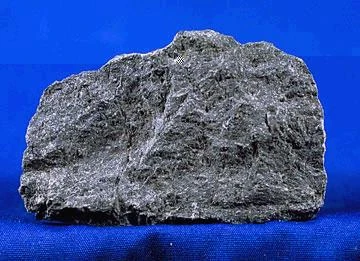
Forsterite
Magnesium-rich end-member of the olivine solid solution series.

Forsterite, also called white olivine and often shortened to Fo, is the magnesium-rich end of the olivine solid solution series. Its chemical formula is Mg₂SiO₄. It shares the same crystal structure as the iron-rich end-member fayalite, and it forms crystals in the orthorhombic system. Forsterite appears in igneous and metamorphic rocks, as well as in meteorites. The gemstone peridot is a variety of forsterite olivine. Pure forsterite contains only magnesium, oxygen, and silicon. Along with fayalite (Fe₂SiO₄) and tephroite (Mn₂SiO₄), it is one of the three end-members of the olivine series. In nature, small amounts of nickel and calcium can replace iron or magnesium in olivine, but only in minor proportions. Other minerals, like the uncommon calcium-rich monticellite (CaMgSiO₄), share olivine’s structure, but they mix with olivine only in limited amounts. Monticellite occurs in contact-metamorphosed dolomites. Pure forsterite does not appear in igneous rocks, but dunite often contains olivine at least 92% forsterite (Fo92), and common peridotite typically has olivine at least Fo88. Because forsterite has a high melting point, it is the first mineral to crystallize from a magma melt during cumulate processes, often alongside orthopyroxenes. Mantle-derived magma commonly produces forsterite-rich olivine, and olivine in mafic and ultramafic rocks is usually rich in the forsterite end-member. Forsterite also forms in dolomitic marble from the metamorphism of high-magnesium limestone and dolomite. Nearly pure forsterite occurs in some metamorphosed serpentinites, while fayalite-rich olivine is much rarer. Nearly pure fayalite appears in some granite-like rocks and is a major component of certain metamorphic banded iron formations. In forsterite’s structure, the anion SiO₄⁴⁻ and the cation Mg²⁺ are present in a 1:2 molar ratio. Silicon sits at the center of the SiO₄⁴⁻ anion, with each oxygen bonded to it by a single covalent bond. The four oxygen atoms carry a partial negative charge, so they must stay far apart to reduce repulsion, which gives the anion a tetrahedral shape. Th
- chemical_formula
- Mg2SiO4
- crystal_system
- Orthorhombic
- space_group
- Pbnm
- discoverer
- Armand Lévy
- named_after
- Adolarius Jacob Forster
- type_locality
- Mount Somma, Vesuvius, Italy
Lore & Background
Pure forsterite is composed of magnesium, oxygen, and silicon, with the chemical formula Mg2SiO4. It is the magnesium-rich end-member of the olivine solid solution series, with fayalite (Fe2SiO4) and tephroite (Mn2SiO4) as the other end-members. Other elements such as Ni and Ca substitute for Fe and Mg in olivine only in minor proportions in natural occurrences.
Reader's Guide
Forsterite is significant as the magnesium-rich end-member of the olivine solid solution series, a key mineral in Earth's upper mantle and in mafic and ultramafic rocks. Its presence in meteorites, cometary dust returned by the Stardust probe, and in the dusty clouds around a forming star highlights its importance in planetary and stellar formation studies. The mineral's high melting point makes it the first to precipitate from a magmatic melt, influencing igneous rock composition. Forsterite's phase transitions into wadsleyite and ringwoodite under high pressure are critical for understanding mantle dynamics. Additionally, forsterite is being studied as a potential biomaterial for implants due to its superior mechanical properties. Its gemstone variety, peridot, has historical and commercial value.
Did You Know?
- Forsterite was named after the English naturalist and mineral collector Adolarius Jacob Forster.
- Two polymorphs of forsterite are known: wadsleyite (orthorhombic) and ringwoodite (isometric, cubic).
- The occurrence of forsterite due to oxidation of iron was observed at the Stromboli volcano in Italy.
Frequently Asked Questions
What exactly is Forsterite?
Forsterite is the pure magnesium end-member of the olivine mineral family, defined by the formula Mg₂SiO₄. It crystallizes in the orthorhombic system (space group Pbnm) and is sometimes nicknamed "white olivine."
What's the connection between peridot and Forsterite?
Peridot is simply the gem-quality variety of forsterite olivine, so the green stones set in jewelry are essentially forsterite crystals clean enough to cut and polish. No separate mineral species is involved—it's the same Mg₂SiO₄ composition.
Who discovered Forsterite and who is it named after?
The mineral was identified by Armand Lévy and takes its name from the mineralogist Adolarius Jacob Forster. Its type locality is Mount Somma at Vesuvius in Italy.
Where do you actually find Forsterite in nature?
It occurs in igneous and metamorphic rocks and is also a common phase in meteorites. Its frequent appearance in space rocks makes it a key mineral for studying planetary formation and differentiation.
How does Forsterite fit into the olivine solid-solution series?
Alongside fayalite (the iron end-member, Fe₂SiO₄) and tephroite (the manganese end-member, Mn₂SiO₄), forsterite forms one of the three terminal compositions of the olivine series. Natural olivine crystals typically represent intermediate mixes blending toward or away from these end-members.
More in Rocks And Minerals 1-24
Elsewhere in the Rocks And Minerals universe
Spotted an error? Know more?
This is a living reference — every entry is fact-audited, and reader corrections feed straight into our audit queue. Suggest an edit · See this site's audit record