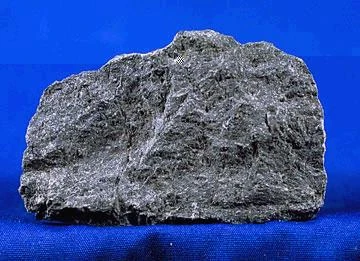
Galena
Primary ore of lead and silver, widely distributed sulfide mineral.

Galena, known historically as lead glance, is the mineral form of lead(II) sulfide (PbS). It serves as the primary ore for lead and is a significant source of silver. Among sulfide minerals, it is both abundant and widespread, typically forming cubic crystals that often display octahedral shapes. Under standard temperature and pressure, a pure specimen of galena held in the hand is insoluble in water and nearly non-toxic, making it safe to handle in settings like museums or geology labs. However, because lead(II) sulfide is reactive in various environments, it can be highly toxic if swallowed or inhaled, especially with prolonged or repeated exposure. Galena has been mined since ancient times because lead can be smelted from it using an ordinary wood fire. It usually occurs in hydrothermal veins alongside minerals such as sphalerite, marcasite, chalcopyrite, cerussite, anglesite, dolomite, calcite, quartz, barite, and fluorite. It is also found in low-temperature lead-zinc deposits within limestone beds, and in smaller amounts in contact metamorphic zones, pegmatites, and sedimentary rock. In some deposits, galena contains up to 0.5% silver, often generating more revenue from the silver than from the lead. This silver occurs as included silver sulfide minerals or as limited solid solution within the galena structure. Such argentiferous galena is almost entirely hydrothermal in origin; galena from lead-zinc deposits contains little silver. Galena deposits are found worldwide. Notable locations include Freiberg in Saxony; Cornwall, the Mendips, Derbyshire, and Cumberland in England; the Linares mines in Spain, worked from before Roman times until the late 20th century; the Madan and Rhodope Mountains in Bulgaria; the Sullivan Mine in British Columbia; Broken Hill and Mount Isa in Australia; and ancient mines in Sardinia. In the United States, major deposits occur in the Mississippi Valley type deposits of the Lead Belt in southeastern Missouri—the largest known deposit—and in the Driftless Area of Illinois, Iowa, and Wisconsin, which gave its name to Galena, Illinois. Galena was also key in the tri-state district around Joplin, Missouri, and in silver mining regions of Colorado, Idaho, Utah, and Montana, notably the Coeur d'Alene district of northern Idaho. Argentiferous galena w
- category
- Mineral
- chemical_formula
- PbS
- crystal_system
- Cubic
- primary_use
- Ore of lead and silver
- associated_minerals
- Sphalerite, calcite, fluorite
- notable_deposits
- Missouri Lead Belt, Broken Hill, Mount Isa
Lore & Background
Galena has been used since ancient times, as lead can be smelted from it in an ordinary wood fire. It typically occurs in hydrothermal veins associated with sphalerite, marcasite, chalcopyrite, cerussite, anglesite, dolomite, calcite, quartz, barite, and fluorite. It is also found in low-temperature lead-zinc deposits within limestone beds, and minor amounts occur in contact metamorphic zones, pegmatites, and disseminated in sedimentary rock. In some deposits, galena contains up to 0.5% silver, making it an important silver ore. Argentiferous galena is almost entirely of hydrothermal origin. Notable deposits include those at Freiberg in Saxony; Cornwall, Derbyshire, and Cumberland in England; the Linares mines in Spain; the Madan and Rhodope Mountains in Bulgaria; the Sullivan Mine of British Columbia; Broken Hill and Mount Isa in Australia; and the ancient mines of Sardinia. In the United States, it occurs in the Mississippi Valley type deposits of the Lead Belt in southeastern Missouri, the Driftless Area of Illinois, Iowa and Wisconsin, the tri-state district around Joplin, and the silver mining regions of Colorado, Idaho, Utah and Montana. The largest documented crystal of galena is composite cubo-octahedra from the Great Laxey Mine, Isle of Man, measuring 25 cm × 25 cm × 25 cm, on display at the Natural History Museum, London.
Reader's Guide
Galena is the official state mineral of Kansas, Missouri, and Wisconsin, and several towns in the United States take their names from deposits of this mineral. Structurally, galena belongs to the octahedral sulfide group, with a close-packed cubic unit cell similar to halite. Within the weathering or oxidation zone, galena alters to anglesite or cerussite. It can be oxidized by naturally occurring bacteria and archaea in acid mine drainage. Historically, galena was used to produce kohl in Ancient Egypt, applied around the eyes to reduce glare and repel flies. In pre-Columbian North America, indigenous peoples used it in decorative paints and cosmetics, and it was widely traded. Galena is the primary ore of lead, used in lead-acid batteries and ceramic glaze, and is often mined for its silver content. It is a semiconductor with a small band gap of about 0.4 eV, used in early crystal radio receivers as a point-contact diode with a 'cat's whisker' wire. In modern times, galena is primarily used to extract its constituent minerals.
Did You Know?
- Galena is the natural mineral form of lead(II) sulfide (PbS).
- The largest documented crystal of galena, measuring 25 cm × 25 cm × 25 cm, is from the Great Laxey Mine, Isle of Man.
- Galena was used in Ancient Egypt as kohl, an eye cosmetic.
- Galena is a semiconductor with a band gap of about 0.4 eV, used in early crystal radio receivers.
Frequently Asked Questions
What is Galena?
Galena is a naturally occurring sulfide mineral with the chemical formula PbS, making it the principal ore from which lead is extracted. It also serves as a notable source of silver and ranks among the most abundant sulfide minerals found in nature.
What does Galena look like crystallographically?
Galena crystallizes in the cubic system and most commonly forms well-defined cubes, though octahedral shapes are also frequently observed. It is often found in association with minerals such as sphalerite, calcite, and fluorite.
Is Galena toxic or safe to handle?
A pure galena specimen at room temperature is insoluble in water and poses minimal risk during normal handling, which is why it appears in museum displays and geology labs. However, ingesting lead(II) sulfide can be extremely dangerous, so the mineral should never be swallowed.
Where are the most notable Galena deposits located?
Some of the world's most famous galena-producing regions include the Missouri Lead Belt in the United States, the Broken Hill mine in Australia, and the Mount Isa deposit. These sites have been central to lead and silver mining for generations.
Why is Galena important to industry?
Galena is the primary ore mineral for lead extraction and simultaneously provides a significant portion of the world's silver supply. Its widespread distribution and abundance make it a cornerstone of metal mining operations.
More in Rocks And Minerals 1-24
Elsewhere in the Rocks And Minerals universe
Spotted an error? Know more?
This is a living reference — every entry is fact-audited, and reader corrections feed straight into our audit queue. Suggest an edit · See this site's audit record