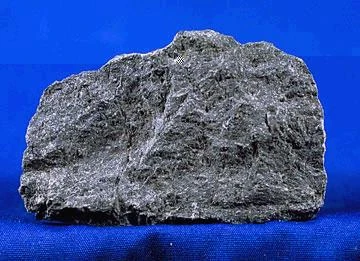
Hedenbergite
Iron-rich pyroxene found in chondrites and skarns.

Hedenbergite (CaFeSi₂O₆, also written as CaFe(SiO₃)₂) is the iron-rich end member of the pyroxene group, crystallizing in the monoclinic system. It is extremely rare as a pure natural substance and is usually synthesized in a laboratory. It is notable for being found in both chondrites and skarns (calc-silicate metamorphic rocks), and as a pyroxene, it has drawn significant interest for its role in general geologic processes.
**Properties** Hedenbergite has a hardness between 5 and 6, two cleavage planes, and a conchoidal fracture. Its color ranges from black to greenish black to dark brown, with a resinous luster. It is part of a pyroxene solid solution series that includes diopside and augite, and it is the iron-rich end member. A key identifying feature is its radiating prisms, which belong to the monoclinic crystal system. The mineral is found mainly in metamorphic rocks.
**Composition and structure** The pyroxene quadrilateral records the compositions of various pyroxenes in igneous rocks, such as diopside, hedenbergite, enstatite, and ferrosilite. Hedenbergite is almost never found in isolation. Its chemical formula shows that the main compositional differences involve calcium, magnesium, and iron. At twenty kilobars, the composition shifted toward clinopyroxenes with little or no hedenbergite. These results indicate that hedenbergite’s stability depends more on temperature than on pressure.
**Effects of chemical composition on elasticity** Pyroxenes are important for geologic processes in the mantle and transition zones. In elasticity studies, one crystal was oriented along the C axis, and another perpendicular to it. The elastic strength of a polyhedron is determined by the cation at its center. As bond length between cations and anions decreases, bond strength increases, making the mineral denser and more compact. Substitution between ions like Ca²⁺ and Mg²⁺ has little effect on resistance
- crystal_system
- Monoclinic
- hardness
- 5 to 6
- color
- Black, greenish black, dark brown
- luster
- Resinous
- cleavage
- Two cleavage planes
- fracture
- Conchoidal
Lore & Background
Hedenbergite is the iron-rich end member of the pyroxene group, part of a solid solution chain that includes diopside and augite. It is almost never found isolated in nature and is usually synthesized in a lab. One of the best indicators of hedenbergite is radiating prisms with a monoclinic crystal system. The mineral occurs primarily in metamorphic rocks, especially contact metamorphic rocks high in iron. At twenty kilobars, the composition shifts toward clinopyroxenes with trace hedenbergite. The stability of hedenbergite is more dependent on temperature than pressure. In chondrites, hedenbergite is the most abundant secondary calcium-rich silicate phase within Allende chondrules, closely associated with sodalite and nepheline. In skarns, hedenbergite occurs in deposits such as the Nickel Plate gold skarn deposit of the Hedley District in southern British Columbia.
Reader's Guide
Hedenbergite holds significance as the iron-rich end member of the pyroxene group, a key mineral family in geologic processes. Its occurrence in both chondrites and skarns makes it a unique indicator of specific metamorphic and meteoritic environments. The mineral's stability, more dependent on temperature than pressure, provides insights into the conditions of rock formation in the Earth's crust and in extraterrestrial materials. Studies of hedenbergite in the Allende meteorite help scientists understand secondary alteration processes in chondrites. In skarns, hedenbergitic pyroxene characterizes certain gold deposits, linking mineralogy to economic geology. The mineral's elastic properties, influenced by cation substitution, contribute to understanding mantle and transition zone processes. Although rarely pure in nature, hedenbergite's role in the pyroxene quadrilateral aids in classifying igneous and metamorphic rocks.
Did You Know?
- Hedenbergite is the iron-rich end member of the pyroxene group and has a monoclinic crystal system.
- Hedenbergite is found in both chondrites (meteorites) and skarns (calc–silicate metamorphic rocks).
- The stability of hedenbergite is more dependent on temperature than on pressure.
Frequently Asked Questions
What is Hedenbergite?
Hedenbergite is the iron-rich end member of the pyroxene mineral group, with the formula CaFeSi₂O₆ (also written CaFe(SiO₃)₂). It crystallizes in the monoclinic system and serves as the iron analogue to the more widespread calcium-magnesium pyroxenes.
What does Hedenbergite look like and how hard is it?
Specimens range from black to greenish black to dark brown and display a resinous luster. On the Mohs scale it sits between 5 and 6, and it parts along two cleavage planes or breaks with a conchoidal fracture.
Where does Hedenbergite occur in nature?
It is documented in chondritic meteorites and in skarns, which are calc-silicate metamorphic rocks. Because pure natural crystals are exceedingly scarce, most specimens circulating among collectors are actually laboratory-synthesized.
Why is Hedenbergite so hard to find as a pure mineral?
In the field it almost always occurs as a minor phase mixed within other rock assemblages rather than as a standalone crystal. This natural scarcity is the reason the mineral is far more commonly produced in a lab for study and display.
Why do geologists and mineralogists care about Hedenbergite?
As a diagnostic pyroxene, its presence helps researchers reconstruct the temperature and pressure conditions that formed the host rock or meteorite. Finding it in both chondrites and skarns makes it a versatile marker across a wide spectrum of geologic processes.
More in Rocks And Minerals 1-24
Elsewhere in the Rocks And Minerals universe
Spotted an error? Know more?
This is a living reference — every entry is fact-audited, and reader corrections feed straight into our audit queue. Suggest an edit · See this site's audit record